Archive Page 9

living proof

I’m busy. Have I mentioned that? I have temporarily bitten off way more than I can chew. I’m not complaining – there is a light at the end of the tunnel. It’s dim, but if I squint, it’s there.
My primary source of entertainment for the last 2 months has come in random 28 minute snippets when I sneak off to stream old Office episodes. I’m pretty sure I’ve subconsciously started channeling Dwight Shrute. I’m not sure if that’s good or bad, but I am considering painting my office walls black to intimidate my subordinates. Wait. I don’t have any subordinates. Damn. Maybe I’ll just put a bouncy castle outside my office instead.
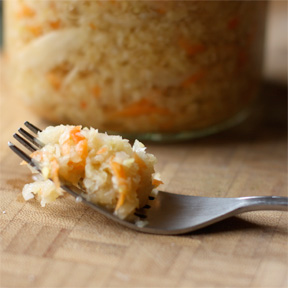
The other night I put on a pot of brown rice, sauteed up some garlic and kale, fried a few eggs, piled it all together and topped the whole shebang with a mound of spicy kimchi. I was so pleased with my accomplishment, I thought I was worthy of a James Beard award. That’s how much cooking I’ve been doing lately. The kimchi was homemade though. It was my last kitchen fun before all hell broke loose. I often find myself going to the fridge mid-day for a forkful, dreamily recalling the days when the produce was plentiful and I had time to spend in the kitchen.
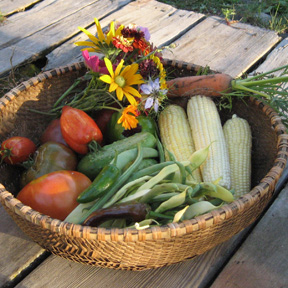
Last night I bundled up at dusk to harvest the last of the kale, chard, and brussel sprouts. I’ve kept them covered with tattered bed sheets, but the jig is finally up. The temperature has been hovering at 26º F for the last few days and the skies have been grey and laden with snow flurries. I’m pretty sure I audibly sighed as I put the last of our bounty into the crisper drawer. It’s not that I don’t appreciate winter and everything it brings, it’s just so hard to say good-bye to the garden. On the most basic level it’s like my own little convenience mart, ready to serve me 24/7. But on a deeper level, it’s my place to go. My reprieve.
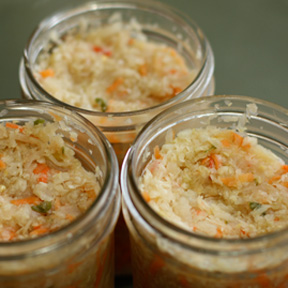
But still, I guess I have the crock pickles, the kraut, and the kimchi. Actual living proof of the garden. Sure, there’s squash, potatoes, and beets too. But somehow those seem less dramatic. Less zingy. My foray into fermentation as a preservation method is relatively new one, but I couldn’t be more excited about it. First off, it’s easy. Way less fuss than canning. But more importantly, the food tastes different. It tastes, well, alive. Because it is. And it fills that deep craving I have for fresh, home-grown food.
This wasn’t always the case, mind you. For the first half of my life, I wouldn’t go near sauerkraut. And kimch? Never heard of it. When I eventually did, I didn’t really want to know anymore. At some point I got radical and granted them “condiment status” on my plate. And luckily, somewhere in there, I was treated to tasting real, home-made versions. They were like completely different foods. And now – now I generously pile them onto sandwiches, stir them into rice, mash ’em into potatoes, top off meat dishes, and stand at the the open fridge door for a quick forkful.
My go to fermentation book is Sandor Ellix Katz’s Wild Fermentation. I’m sure I’ve mentioned him before, but one of the things I appreciate is his simplistic, small scale approach. I can crank out a quart of kraut or kimchi in less than a half hour of real work, and even then, my Cuisnart does most of it. There is some checking and periodic tasting involved, but if you forget about it for a few days, it doesn’t matter. For the most part, it just sits inconspicuously in the corner while the fermentation does all of the real work.

Spicy Cabbage Kimchi 
(adapted from Wild Fermentation)

1 pound napa cabbage
a handful of red radishes
2 carrots
sea salt and water

Grate or chop the vegetables. I think kimchi is traditionally pretty coarse, but I prefer a finer version (a Cuisnart does a marvelous job at this – especially if you happen to be busy!) Mix up a brine by combining about 4 cups cold water and 4 tablespoons salt water. Make sure all the salt dissolves and then taste it. It should taste like the sea. Put your vegetables in a large ceramic bowl and pour the brine over them. Use a plate with a weight on it to completely submerse the vegetable. Cover with a clean dish towel and let soak over night.

Next you need a spice mix. Definitely tailor this to your taste buds. This is my latest favorite combination.

1 small onion plus a handful of shallots, chopped
1 head of garlic, chopped
4 hot chilies (in my last batch I used Chillipeños, but use whatever you have, fresh, or dried, seeded or not)
2-3 tablespoons fresh gingeroot, grated
a splash of fish sauce

You want everything in the spice mix all pretty finally minced and mixed together into a paste. Again, the Cuisnart is invaluable for this.

Drain the brine from the veggies, reserving it. Taste the vegetables for saltiness. You want them to be decidedly salty, but not unpleasantly so. If the seem way too salty, give them a rinse under cold water. If they don’t seem quite salty enough, sprinkle a few teaspoons of sea alt on them.

Mix the spice paste in to the veggies and work it in so everything is combined. pack the mixture tightly into a quart jar, pressing down on it as you go so that the brine begins to rise above the vegetables. And that’s it, your work is basically done. Now the jar sits in a quiet, out of the way place in your kitchen for 1 to 3 weeks. The only ting you have to be sure of is that the vegetables stay below the brine. You can do this by just plunging them down back into the brine every day with your hands, or use a weight – like a smaller jar or ziplock filled with some of the reserved brine. Cover the jar with a clean towel and check it every few days to see how it is progressing. Over the corse of a week or more (depending on temperature) the kimchi will start to ripen and get that nice little zing. When it gets to tasting how you like it, cap the jar with a lid and store it in the fridge.
grandma rose

I actually don’t have a Grandma Rose. I had a Grandma Marjorie and a Grandma Myrtle. But my Italian friend, Gina – she had a Grandma Rose. And a few weeks ago, I got to know Grandma Rose a bit. Lucky me.

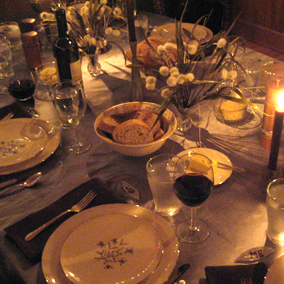
I’m married to a Libra. Coincidentally, four of my closest friends (there is a fifth, but work moved her out of the area) are also married to Libras (and okay, there’s one Scorpion in there, but he’s on the Libra cusp). Nevertheless, Gina has graciously taken it upon herself to throw these boys a birthday dinner each October. I’ve often felt that I completely lucked out in meeting and marrying my husband, and this is just one more perk to add to the list. Gina puts such thought into each year’s theme and meal. And she insists that we do it properly and get all gussied up. It’s a dinner that I look forward to all year long.
Inspired by a trip to Montana this past summer, Gina decided to cook a genuine Italian feast for this year’s dinner. Now I know know Montana and Italy aren’t commonly associated with each other – especially when food is on the line. But Montana is where scores of Gina’s Italian cousins and aunts live. And so they gathered to cook, to teach, to learn, and to remember Grandma Rose. Prior to the trip, Gina compiled a small booklet of Grandma Rose’s recipes – complete with typos and all. I have a copy. I love it. I live for family stories like this.
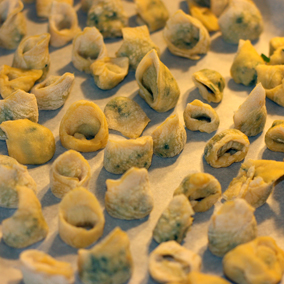
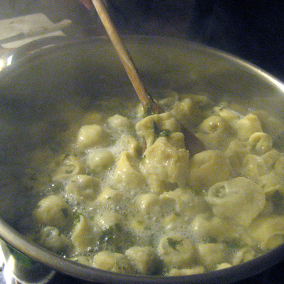
The highlight of this year’s birthday dinner (for me at least) was that we got to help prepare it. I’ll be first in line for a cooking lesson any day – especially one with friends. Gina invited us to gather at her kitchen table on Friday morning to help make TORTLACH – also referred to as  “large hats.” Large hats stuffed with an amazing cheese, spinach, breadcrumb filling. Not to be confused with TORTELLINI, Gina explained  – which are “small hats” stuffed with a pork based filling. While making the filling, Gina told us about her Grandma Rose, her food, her cooking, her roots. I smiled when I realized that the more Gina talked, the less she was actually following the recipe that was laid out in front of her. By the end it was a handful more of this, another pinch of that. Gina was doing it all by feel. Grandma would be proud.
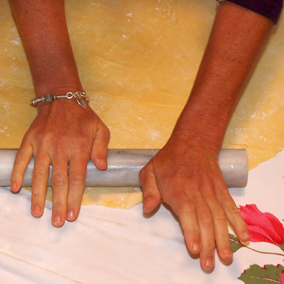
Filling ready, it was time to roll out the pasta dough. A flowered tablecloth covered our work surface. I mentioned I had never thought to roll out dough on a cotton cloth. “That’s how we know it’s thin enough,” Gina instructed. “We roll until we can start to see the flower print through the dough.” And yes, we were rolling the dough out on Rose’s tablecloth. I felt honored. Gina coached us, intervening when necessary, and we took turns rolling until sure enough, we could see faint flowers. Gina cut the dough into thin strips and then into squares. Then she gave us a quick “large hat” making lesson. Fill, pinch, wrap around thumb, pinch again.
“Now this is what it’s all about,” Gina proclaimed, as we all pulled our chairs up around the table. “This is where we dish out the gossip.” We joked around as we fumbled our way through making our inaugural large hats. But as filling and making the hats came more easily, so did the conversation. Before we knew it, two hours of talk had slipped away and the counters were overcrowded with trays of tortlach.
We hugged our good-byes and departed filled with anticipation for the next night’s meal. I drove home, feeling accomplished and feeling blessed. Back at my desk life felt richer. And how could it not? I had gained a third Grandma, at least for the day.

garlic pusher

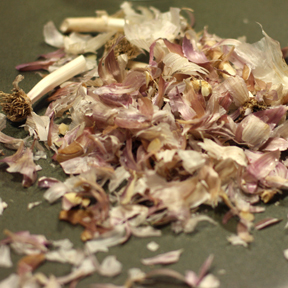
I fear that I’ve been a little remiss at promoting the planting of garlic. Now is the time people! At least in the northern hemisphere. Really anytime between the end of September and right up until the ground freezes works. I shoot for mid-October here in northern Wisonsin. It doesn’t always work out that way, but fortunately, garlic is pretty forgiving.

Ideally you want the garlic to get a jump on growing and set down a few roots before winter sets in. Then come spring it will shoot up as the ground thaws and be on its way. It’s really a glorious sight. If push comes to shove, you can even plant in the early spring, but who really  wants to stick their fingers into icy cold soil? Do it now, while there is a least a glimmer of summer left.

Ready for a garlic planting crash course? It’s really easy, I promise.

1. Find yourself a few nice heads of garlic – ideally of a variety you enjoy.

2. Break apart the head into individual cloves. Pick out the largest ones and set aside any itty-bitty ones for eating. Leave the paper skin intact, but don’t worry if a bit of it pulls away.

3. Find yourself a patch of loosely fluffed soil – even a big pot on the deck or in the garage will work. Maybe work in a bit of compost if you have it.

4. Poke each clove in (root end down, pointy tip up) about twice as deep as the clove itself, 6 to 8 inches apart. Give a little pat of encouragement to each clove as you fill in the soil around it.

5. Put a good layer of mulch (by good, I mean 6-8 inches worth) over the top of your patch. I use straw, but leaves would work too. If you are leaving a pot on the deck, mulch it extra well around the sides too so it doesn’t freeze too hard. I think a shed or garage would be the best bet. Then just drag the pot outside in the spring.

And that’s it. I assure you that the hardest part is waiting. But it’s so worth it. Because if you’ve planted a little extra (did I mention you should plant a little extra?) you can harvest a few shoots of pencil-thick green garlic in the early spring and make amazing things with them. Even if you didn’t plant a little extra, you’ll still be okay. Come June you’ll get a fine crop of twirly scapes that you can make more amazing things with.

If all goes well, by late summer you’ll have significantly more garlic than the few heads you started out with. Which means fewer vampires and more amazing things in the kitchen. Like this garlic sauce, which is deliciously good on almost everything. Just keep an eye out for the devil.

The Devil’s Sauce
(adapted from Chester Aaron’s Garlic is Life)

2 red or mild banana peppers, coarsely chopped
1/2 – 1 habañero chile, seeded and chopped
1 cup chopped onion
3 tablespoons red wine vinegar
2 tablespoons olive oil
2 tablespoons sugar
1/2 teaspoon cumin
1/2 teaspoon adobo seasoning (or use all cumin)
4 tablespoons red pepper flakes (aleppo if you have it)
10 large garlic cloves (about 3-4 ounces), roasted*
1 1/2 teaspoons sea salt
black pepper to taste

*I use Romanian Red garlic, which has fairly large cloves. If you’re using a variety with smaller cloves, you may need way more than 10 cloves to make 3-4 ounces. To roast it, put the individual cloves in a little foil packet, drizzle with some olive oil, salt and pepper and roast at 350ºF for 45 minutes to an hour until cloves are tender and can squeeze easily out of their papers.

For the sauce, blend the peppers, chile, and onions in a food processor to make a purée. Transfer to a saucepan and add the vinegar, oil, sugar, cumin, and adobo, and pepper flakes. Simmer gently for about 5 minutes before adding in the roasted garlic. Mash everything up a bit and simmer for about 5 more minutes. Add salt and pepper and adjust to taste. Makes about 2 cups. Store in fridge, freeze, or pressure can (15 minutes at 10 psi).

girl talk

I tell my bees everything. From the mundane to the monumental, they get to hear all sorts of news from me. I especially like to tell them my troubles. They seem to have a way of talking me down from just about anything. They’re always so calm and practical. Their attitude sort of rubs off on me. And after a while, my problems generally seem less problematic. I can’t really explain it, but I’ll take it.
There is plenty of folklore out there that suggests bees should indeed be kept in the loop. Old timers will tell you that a hive will swarm if they aren’t informed of big news. This bit of Celtic wisdom nails it:
Marriage, birth, or burying, 
News across the seas, 
All your sad or marrying, 
You must tell the bees.

And I get chills when I read about the ritual of tapping three times on a hive to let the bees know that their keeper has died. There is a beautiful Deborah Digges poem about this gloomy task.

In the spring and summer I look in on my bees about once a week, which means I get ample time to gossip. Sometimes I even run out of things to say. But even then it’s an easy silence. Basically visiting with my bees is a little mini-escape. It’s like having coffee with a good friend. So I always get a little nostalgic on my last visit to the bee yard of the season. Sure, I’ll check in on them all winter long, but I won’t open up the hives again until early spring. So I take my sweet time tucking them in for winter.
After the fall asters and goldenrod have dwindled I usually give each hive a couple of pails of sugar water. This helps to bolster their winter food supply – one of the most critical factors affecting their odds of winter survival. And then some time before the end of October, ideally on one of those last sunny, brisk afternoons, I’ll pull off the food pails and literally wrap up the hives. I use a black plastic that is backed with a thin layer of insulation. I top each hive with a piece of moisture wicking construction board so that any winter moisture – another key survival issue – gets drawn out of the hive. I also make sure to leave an air opening on the top and bottom of the hive so that air will circulate though, hopefully keeping things nice and dry.
I especially like the top hole because it means I can peek in and see what the girls are up to. Even in the dead of winter I can usually coax a few girls out onto the opening. I like to think they are spreading any news I’ve brought once they scurry back into the warmth of the hive cluster.
We’re having such a splendid fall that I’ve been putting this job off for as long as I can. After a few nights of hard frost though, I know it’s finally time. So this afternoon I packed my lunch with a thermos of tea and headed out out to the hives to bundle the girls up for a long winter ahead. But not without telling them the news of the day.

knock your socks off

Remember Earl? Our foster dog? Well, it’s official. We’ve gone and adopted him for keeps. Earl (like a lot of rescue dogs) arrived at our door with some baggage. Something tells me he still has a bit of unpacking to do, but I’m not too worried. So far we’ve been able to deal with everything he’s pulled out of his case.

Near as I can tell, his main ambition is to sit as close to people as is physically possible while making curious little squeaking noises. It’s become clear to us that Earl is not familiar with the concept of the personal space bubble. Still, it’s sort of endearing. He’s a funny little guy. Baggage and all.

But here’s the thing about Earl. Actually it’s two things.
1. You simply can not, in any way, be in a hurry around Earl. It doesn’t work. He’s nervous enough as it is, but he gets especially anxious when people start rushing around. So it’s best to just move slowly and yawn a lot. And you should sort of plan on things taking a while. It could take 45 seconds to load up in the car, or it may take 17 1/2 minutes (a new personal record). You never can tell.
2. There should always, always be a stash of treats in your pocket. Always. If nothing else, it increases the odds of things going a little quicker. Earl is partial to beef flavored Pup-Peroni sticks. I myself like a nice butterscotch button.
So far these have pretty much been Earl’s only special needs. And really they aren’t such bad rules to live by. Who here couldn’t stand to take it down a notch? Anyone? And keeping a stash of nice little treats on hand? That’s pretty much a no-brainer. So I’m gradually learning to pad my schedule a bit – it’s kind of refreshing to feel a little less rushed. And I really have been eating a lot of butterscotches lately. Which is nice, because I’d sort of forgotten how much I enjoy butterscotch. And it has also reminded me of a delicious cookie combination. Ginger and butterscotch.

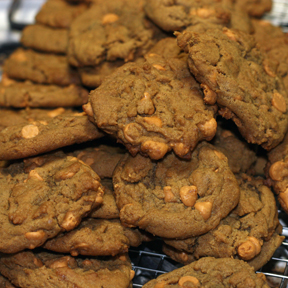
I first had this cookie a few years ago at Rabbit’s Bakery – a cozy little shop near my Mom’s in Lake City, MN – and it knocked my socks off. It might not be for everyone, but if you dig these two flavors, I assure you they were meant for one another. It’s a perfect fall weather cookie too.
So yesterday, on our first real cool, rainy day of the season, Earl inspired me to slow down, turn on the oven, and bake. And on our next sunny fall day, I plan to head out to the nearest leaf pile, cookies in one pocket, Pup-Peroni sticks in the other and take in the last rays of fading summer sun with my new friend. Why not?
Ginger-Butterscotch Cookies
(adapted from Nestle Tollhouse)
3 cups flour (I like a combo of white and whole wheat)
2 teaspoons baking soda
1 1/2 teaspoons ground cinnamon
2 teaspoons ground ginger
3/4 teaspoon ground cloves
1/2 teaspoon salt
1 cup butter
1 cup packed brown sugar
1 large egg
1/3 cup full flavored molasses
8 – 11 ounces butterscotch chips
Sift flour, baking soda, cinnamon, ginger, cloves and salt in small bowl.
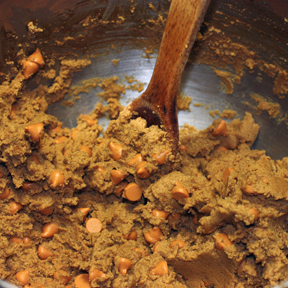
Beat butter, sugar, egg and molasses in large mixer bowl until creamy. Gradually beat in flour mixture until well blended. Stir in butterscotch chips. Drop by rounded tablespoon onto ungreased baking sheets.
Bake for 10-12 minutes at 350º F until lightly browned. Cool on baking sheets for 2 minutes and remove to wire racks to cool completely.
Makes about 4 dozen

cold chaser

This is going to sound pathetic, but I have been trying to turn out a batch of chocolate chip cookies since the beginning of September. My husband Mark is a science teacher at Bayfield High School. And I know from experience that the transition back into the chaos of the classroom can be a rough one. So naturally I thought chocolate chip cookies would help.

I must have taken the butter out to come to room temperature at lest a dozen times, only to return it – untouched – back to the fridge at the end of another long day. When I finally did get the dough mixed up, it was a two day affair to get all the cookies into the oven and baked. And after all that, they didn’t even come out looking very pretty. But at least they taste good.

It appears, however, that my efforts might have come a little too late. Mark flopped down on the couch this weekend and succumbed to his fate. “They finally  got me,” he moaned. It’s inevitable. It happens every fall. It’s only a matter of when. The dreaded back-to-school cold. And this year’s is a doozy – already making its way deep into his lungs.

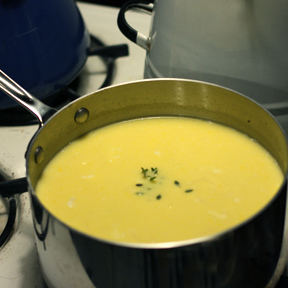
But this time I was ready for duty. Garlic! This boy needs garlic and lots of it. And so as a cure for Mark (and a preventative for myself) I made up a steaming pot of garlic soup. It’s a simple soup with just a handful of ingredients, but don’t let that fool you. Its flavor is rich and complex. Head cold or not, if it doesn’t bolster your spirits after a long day, I don’t know what will.

The key is to make this soup with the freshest garlic you can find. Older garlic runs the risk of being too hot and sharp. This time around I used a nice mild Spanish Roja. The recipe, which comes via the New York Times Cookbook, calls for roughly 36 cloves of garlic. Since garlic cloves can vary quite a bit in size, I’ve settled on average clove weight of 3 to 4 grams. So depending on the garlic I’m using, I typically chop up anywhere from 100 – 150 grams of garlic. Cold? What cold? I knew it was working when midway through dinner Mark sighed and said he wanted to drink the soup like milkshake.

Soupe à L’ail (garlic soup)
Adapted from the Essential New York Times Cookbook

2 tablespoons unsalted butter
36 average size, cloves of garlic (100-150 grams), peeled and roughly chopped
8 cups water
Salt and ground pepper to taste
3 ounces capallini or other thin pasta, broken into pieces
6 eggs, separated
3 tablespoons white wine vinegar
Fresh thyme for garnish
Olive oil

Melt the butter and oil in a large soup pan. Add the garlic and cook, stirring for about a minute – do not let it brown. Add the water and about a teaspoon of sea salt. Bring to a boil, cover, reduce heat and simmer for 15 minutes.

Strain the cooking liquid and reserve the garlic. Put 1/2 cup of the cooking liquid and all of the garlic into a blender or food processor and whiz into a smooth puree.

Return the rest of the cooking liquid along with the garlic puree back to the soup pot and bring it to a boil. Add the pasta. Cook for about 3 minutes, until pasta is just tender. Meanwhile, blend the egg yolks with the vinegar.

Turn off the heat, pour the egg whites into the hot soup, cover and wait a few minute until the egg white form a cloud-like mixture. Do not stir them in. When the whites are fully cooked, add the egg yolk/vinegar mixture and stir very slowly to combine. Adjust seasoning if necessary. Garnish with a sprig of fresh thyme and a drizzle of olive oil.

the patience of garlic

I hate it when real life gets in the way of my fantasy life. You know – the one where I make my living as a small scale garlic farmer, maybe opening a donut cart on weekends to make ends meet. A girl can dream, can’t she?
But the reality is that I’ve hit the ground running this fall. My normal design work is kicking back up after a lazy summer lull. I’m taking a couple of online classes at the Minneapolis College of Art and Design (let me tell you, it’s been a long time since I’ve had to follow a syllabus, take quizzes, and turn in homework). We’re in the throes of designing a small new house that will hopefully be built on our land this winter. Which means we’re also in the throes of figuring out how to finance a small new house. Oh, and to add a little more chaos, we’re fostering (read: probably adopting) a rescue dog. Somebody pass me a donut, please.

Earl is a great guy. I can tell you that he has completely won my heart. But Earl is nervous. Very nervous. It’s a crazy world out there, riddled with surprises. Earl will be the first to tell you. So we’re working on this, trying to instill as much calm and stability as we can. And really he is making loads of progress.
I am lucky enough to live within a half mile of a splendid view of Lake Superior, Madeline Island, and on clear days – Michigan’s upper peninsula. Earl and I have made a habit of trudging (this happens pre-coffee) up the hill each morning. And when we get to the top of the hill, we check on the lake to make sure it is still there. Sixteen mornings straight now, it has been there for us. It’s nice to have something you can count on. Ask Earl.
Truthfully though, I go check on the lake for my own sanity as much as anything. My days lately have been frantic and overflowing with things to do. Uncomfortably so, at least for my taste. My morning hike to see the lake is a respite. It wakes me up – literally and figuratively. I take a deep breath in, swallow as much of it as I possibly can, and turn back down the hill towards my day.
On the way back inside, I pass by my shed of curing garlic. I look at is wistfully. It needs to be cleaned, trimmed, sorted, inventoried, and stored. But that’s the nice thing about garlic – it’s patient, it’ll wait. I explain to the garlics that maybe some day I really will be a professional small scale garlic farmer. But for now, they’re going to have to put up with my juggling act. At any rate, when I do get to the garlic, and I will, there is bound to be a surplus. I’d love to share it with you. If you’re interested, drop me a note (here) and I’ll keep you posted on what’s available. In the meantime, breathe in and swallow deeply.

maybe

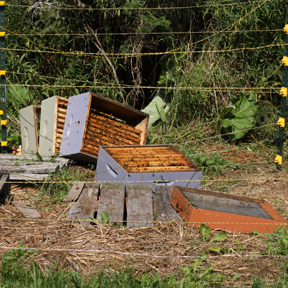
I was in the middle of my workday last week when I got a call. It wasn’t a particularly happy call. “One of your hives is down.” It was my friend Kathy calling from Bayfield School where she teaches 5th grade. A bus driver that drives by my beehives regularly had stopped in her classroom to tell her the news. He knew she would get the message to me. My heart sank. A “hive down” only means one thing. It means a black bear has paid a visit.

I keep eight strands of wire around my beehives with an alternating current that emits 8000 volts of juice. Innocent dogs have touched their noses to it and spent the entire afternoon recuperating. But that’s what it takes to keep – to keep, how should I put it? To keep “well padded” bears at bay. I hurriedly finished up the project I was working on and headed out to the bee yard. My mind was racing on the drive over. Which hive, I wondered? Please don’t let it be Freeda’s. She’s had enough set backs lately. I pulled into the bee yard to an empty silence. No tell-tale clicking from the electric fencer. The amount of bee traffic in the air seemed diminished.
It took me at least a full minute before I could look. Drats. Freeda’s hive was in shambles. Things could have been worse, really, but still it was a sad sight. I got straight to work getting her hive put back together. The girls were frantic, of course. My explanation for what had happened felt meager at best. After a bit of reassembling I realized that an entire frame was missing from one of the brood boxes. (The whole bear and honey thing? It’s a myth. What they’re really after is bee larvae. Though I’m sure they don’t mind their snack slathered in a bit of honey.)
This bear meant business and my dander was up. Dip your paw in, fine. But don’t wander off with an entire frame of bees. I headed off into the woods in a huff, following a flattened down trail behind the hives. At some point, instinct kicked in. It occurred to me that I might not actually want to find the bear in question. I wasn’t sure exactly how I would ask for my bees back. I reluctantly retreated.
Back at the hive, I did a quick search for Freeda’s recently hatched daughter. No luck. One thing I have learned after years of beekeeping is to accept that when I am actively looking for the queen, I probably won’t find her. But on the days when I’m not in a hurry and the weather is especially fine, I’m bound to see her long slender torso moving across a frame. I tried to take this to heart. As much as I wanted to keep looking, I resisted, knowing that what the girls needed most was some order and calm restored to their home.
With my main task completed, I turned my attention to the fencer for a little troubleshooting. Luckily it was fluke and a quick fix. The breaker to the outbuilding that supplies the power had been tripped. I reset it and the reassuring clicking resumed. All I could do was hope it would be enough to ward off a bear with a whetted appetite.
I drove back home, trying not to dwell on the fact that the new, young Ms. Freeda could have been on the missing frame. And that she very well might now be residing inside a black bear’s stomach. And that her hive just went through the arduous process of raising a new queen. And that winter is coming. Time is too short for them to do it all over again. I remembered how giddy I felt the other week when I discovered that Freeda’s daughter had hatched and survived the odds. And then I laughed. I was thinking of a little tale that I leaned from my Dad. I took it to heart. And I felt better. Because after all, embracing the concept of “not knowing” is what makes room for life’s potential.
There is an old Chinese tale about a farmer whose horse ran away. His neighbors gathered that night to bemoan his loss. ‘Too bad, too bad,’ they sighed. ‘Maybe,’ the farmer said.
The next day, the horse came back, leading seven wild horses behind him. ‘Oh, aren’t you lucky!’ the neighbors exclaimed. ‘Maybe,’ the farmer said.
The next day, the farmer’s son tried to ride one of the wild horses, but he was thrown and broke his leg. ‘Oh, that’s terrible,’ the neighbors agreed. ‘Maybe,’ the farmer said.
The next day the soldiers came to conscript young men for the army, but they didn’t take his son, because his leg was broken. ‘How wonderful for you!’ the neighbors cried. ‘Maybe,’ the farmer said.

on the horizion

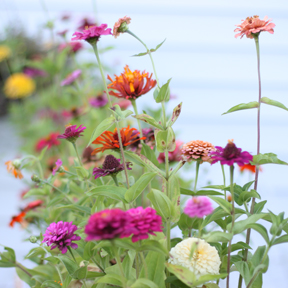
Like usual, I stood on the roadside last Friday cooling down after my late afternoon run and rifled through the mail. Continuing ed flyer from the local college, bill, bill, WI public radio fall sweepstakes form, and the New Yorker. One look this week’s cover by Istvan Banyai and I realized the source of the funk I’d been in all week. I so desperately want to pause. I want to put it all on hold. I want the the little vase of sweet pea blooms on my window sill to last forever. I want to lay down in the corn patch and stare up at the blue for as long as long as it takes. I want to disappear in a book at the beach and smile later when sand spills out into the bed. I want to live on cold-pressed iced coffee and tomato sandwiches. Is that asking so much?
My Dad and I used to play a little game with the New Yorker covers. Each week, we’d try and guess the cover caption. We’d phone in our contenders on Sunday night and whoever came the closest to the real title won a buck. He’s been gone for over six years, but I still can’t help playing the game (and by my calculations, he owes be big). I was mesmerized by this week’s cover. It sucked me in and held me. All I could think was “Pause.” I flipped a few pages in. The real title – the winning title – was “On the Horizon.” Which, in retrospect was even better. “Pause” suddenly felt a little stagnant. “On the Horizon,” though, now that holds potential.
Because as much as I want the heady smell of sweet peas to grace my kitchen, something way deep inside of me also longs for the scent of that first pot of stew, that hint of roasted garlic wafting from the oven, and the unmistakable smell of pine sap oozing from a burning log. And as much as I love my daily routine, my job, my path, it’s undeniably exciting to wonder, “what’s next? what is on the horizon?” Who knows, maybe some bit of change will sneak up on me when I least expect it.
My mood lightened as I walked down the driveway. Summer will be back. I can count on that. But I appreciated – maybe for the first time ever  – that it’s all the fragile, tenuous stuff in between that makes it so worthwhile, so precious. Revelations aside, I wholeheartedly suggest you live large while the living is good. Do yourself a favor and eat as many tomato sandwiches as you possibly can.
p.s. For anyone who is wondering, Queen Freeda’s daughter is alive and well. She is laying a pattern of brood that would do her mother proud. I can hardly wait to watch her legacy unfold!
garlic pig tamaty sandwiches 

1 loaf good, crusty bread, sliced
mayonaise
vine ripe tomatoes, sliced (sun-warmed if possible)
raw garlic, thinly slivered (I prefer Creole Red, it’s a great raw garlic)
fresh basil, chiffonade
Jane’s Crazy Mixed Up Salt (any old salt will do in a pinch)

Slice the bread. Spread on a generous layer of mayo (this is no time to be shy). Add tomato slices, garlic slivers, and basil. Sprinkle with a flourish of Jane’s. Go crazy. Summer comes but one a year.

let’s camp!

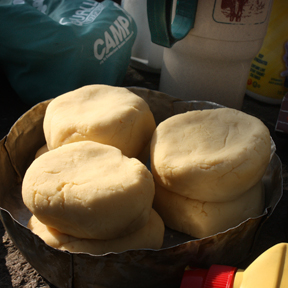
Forgive me. It’s the height of summer (at least up here in Northern Wisconsin) and the garden is finally overflowing. So I feel like I ought to be rattling on about all the ways I have been using my glorious vegetables. But what really has my attention at the moment is biscuits. Mile-high, flaky biscuits. See, I went camping last week with my childhood friend Kathryn. And when Kathryn and camping get together, you can pretty much bet there will be biscuits involved. On this particular trip, it was Kathryn’s dad, Gary, who made the biscuits. But still, there were biscuits. Warm biscuits with butter and honey. Could there be a better way to start a day?

To accommodate his daughter’s dietary needs, Gary went all out and tried his hand at making gluten-free biscuits – how sweet is that? Truth be told, they were a bit heavier than your average biscuit. But they were still biscuits. Warm biscuits with butter and honey. And I can assure you that there is certainly not a better way to kick off a day of paddling than with a belly full of biscuits. I give Gary an A+ for effort. His biscuits reminded me that I have been meaning to try a recipe from a delightful little cafe I visited in Charleston, SC earlier this spring.
I decided a batch of these old-fashioned biscuits would be just the thing to help me ease back into work and the daily routine. I could take them outside with my morning coffee and pretend like I was still camping. Perfect. I knew I had some White Lilly flour lingering in my freezer that my mom had lugged home from Charleston. White Lily is a low-gluten flour made from Southern grown soft winter wheat. It’s the type that makes extra fluffy quick breads and biscuits. You can substitute cake flour or other low-gluten flours to achieve the same results.
While these biscuits may be low-gluten, they aren’t exactly low-fat. But they are so worth it. Especially if you take them outside and pretend like you’re camping. The recipe, which comes from a fun little hand-illustrated cookbook published by the Hominy Grill, calls for all three of the traditional fats – butter, lard, AND shortening. But it’s okay – we’re camping, remember? I don’t keep shortening on hand, so I kept the amount of fat called for the same, but replaced the shortening with butter. I’m sure a true southern cook would detect this omission, but my taste buds were none the wiser for it. And you could no doubt get by with using all butter.
To even further soften my transition back to reality, I made a side of Honey-Thyme Butter to accompany my biscuits. I was inspired by a Honey-Thyme Ice Cream recipe from Amanda Hesser. It’s such a great combination that I wanted to try it in butter as well. I used lemon thyme with the butter and it was perfectly lemony. I’m sure regular thyme would be equally as tasty. For an even more savory treat, try adding a pinch or two of fresh minced garlic into the butter. Maybe it’s just me, but I love the taste of garlic, butter, and honey. A blend that I accidentally discovered years ago while camping – of course!

And since I don’t want to completely short-change you on the vegetable front, I’ll at least tip you off to some of my favorite combinations this summer.

Cukes: Toss coins or matchsticks with a bit of seasoned rice vinegar, toasted sesame oil, salt and red chili flakes

Zucchini: A riff on a 101 cookbooks recipe, caramelize some shallots and garlic, toss in a layer of zucchini coins to brown on both sides and finish if off with a healthy handful of chopped dill and crumbled feta. Left unattended, I can polish off an entire pan of this in a heartbeat. It also makes a great lunch stuffed into a pita.

Green beans: This concoction is adapted from the now defunct Fhima’s in downtown St. Paul. Combine equal parts teriyaki and peanut butter, add in fresh garlic, chopped green onions, and cayenne to taste. Serve over lightly steamed green beans.

Mile High Biscuits
(adapted from the Hominy Grill)

4 cups flour, plus additional for kneading
(use a southern biscuit flower or substitute cake flour)
2 tablespoons baking powder
2 teaspoons sugar
1 teaspoon salt
8 tablespoons butter
2 tablespoons lard
1 1/2 cups buttermilk

Sift the dry ingredients together into a large bowl. Cut in the butter and lard with a fork or pastry cutter until you get pea sized lumps of butter. Add in the buttermilk and mix until the ingredients are just moistened. Turn out onto a floured board and knead a few times until a ball forms. Roll or pat the ball into a circle about 1 inch thick. Cut out biscuits with a lightly floured cutter and transfer them to a baking sheet. Bake the biscuits in a 425ºF oven for about 15 minutes, or  until they are golden brown. Makes about 12 2 1/2 inch biscuits.

Honey-Lemon Thyme Butter

6 ounces butter, room temperature
4 tablespoons liquid honey
1 tablespoon fresh chopped lemon thyme
a pinch of fresh minced garlic (optional)

Combine and mix well, chill slightly.


instapig

No Instagram images were found.