Archive Page 14

hot pop

When it comes to popcorn, I’ve always been an Orville Redenbacher kind of girl. I think it was an early association I formed with my grandpa, whom I shared many a bowls of popcorn with, and who – coincidentally – also happened to be named Orville. I’ve tried my fair share of bulk co-op popcorn over the years too, but I often find myself reverting back to Orville’s famous gourmet popping corn. It still thrills me to open that vacuum-sealed jar. I can’t, however, say that I notice much of a taste difference between the two (sorry Orville). As long as there is a full jar of popcorn on the shelf, I’m satisfied.

Satisfied, that was, until one night last winter when my friend Danielle came to dinner. She brought her husband Jon along too, but almost as importantly, she brought us a jar of her uncle’s homegrown popcorn. It was a striking mix of ruby red and golden yellow kernels. I put it on the pantry shelf and it seemed to positively sparkle next to the neighboring jar of Orville Redenbacher’s.

It was so pretty that I actually put off popping it for quite some time. But when I did, I was forever changed. The popped kernels, albeit slightly more petite than Orville’s, were light and crisp with a freshness that I am sure I have never experienced. And the taste. It tasted like, well – corn. Sweet and creamy and crisp all at the same time.

I managed to stretch out the contents of the jar through the winter – supplementing with Orville’s and selfishly saving the good stuff for nights I knew my husband would be away. And in January when the garden seed catalogs started pouring in, I curled up on the couch and got serious. I settled on Pennsylvania Dutch Butter Popcorn. I am frequently swayed by the word “butter” in descriptions, and this was no exception.

And so this past summer, for the first time in my 17 years of gardening, I dedicated a corner of our plot to popcorn. I planted three four foot diameter circles two weeks after the sweet corn went in to avoid cross-pollination. I had a few setbacks over the summer, including a raccoon incident on a weekend we left town, and several discouraging remarks from friends saying they had tried popcorn in the past, but never found our growing season to be long enough. But I kept the faith and tended my circles. I shored up the breach in the fence, and was graced with a long, sweet fall. Shortly before out first frost on October 29, I harvested one full jar of corn. Still not entirely convinced of my success, I put a handful of kernels straight into the Whirley Pop. And sure enough, it popped! And the taste? Even better than I remembered. I’m already scheming how to fit more popcorn circles into next year’s garden.
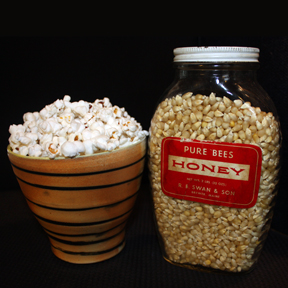
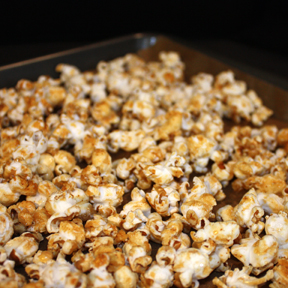
I prefer to pop my popcorn in hot coconut oil and top it off with nothing but a sprinkling of Penzy’s Garlic Salt. But I also have a favorite honeyed-cayenne popcorn that I like to make for special occasions. It’s a great appetizer to serve at dinner parties – a little unexpected, but still sophisticated. In fact, I think it would make a lovely Thanksgiving Day hors d’oeuvre. Snoopy would be so proud.

A few notes on the recipe. I adapted this years ago form a recipe I clipped from Cooking Light. The original recipe calls for pure maple syrup, but since I have more bees in my possession than maple trees, I tweaked it to use honey. Both are quite good though. Omit the water if you go the maple route. I also increased the amount of corn for a better popcorn to syrup ratio. You can vary the amount and type of chili pepper. I have settled on 1/4 teaspoon cayenne as my favorite. It makes a fairly spicy snack, but the honey balances it perfectly. Use less pepper for a tamer treat. A rounded half cup of kernels yields about 12 cups of popped corn. I always toss a little extra in the popper just to be sure, and am generally left with some to snack on while I cook. Depending on your popper, you might have to pop in two batches. This recipe is easily halved, but the full recipe is a nice amount when there are a few guests mingling about. It also stores for a week or so in an airtight container.

Honeyed Hot Pop

10-12 cups popped corn (popped in just a hint of oil)
butter for the bowl
1/2 cup honey
1 tablespoon water
1 tablespoon butter
1/2 teaspoon salt
1/4 teaspoon cayenne pepper (or less)

Rub a bowl large enough to hold the popped corn lightly with butter and add popped corn.

Heat the honey, water, butter, salt, and cayenne over medium heat in a small heavy sauce pan. Stir until everything is just combined and then let it come to a boil. Let the mixture boil without stirring for 2 minutes. Pour the hot syrup over the popcorn and stir to coat.

Line 2 heavy rimmed baking sheets with parchment and spread the popcorn between the two pans. Bake in a 300º F oven for 15 minutes, flipping and rotating the two pans halfway through. Remove from oven and let cool completely. The popcorn will crisp up as it cools.
last hurrah

The transition from fall into winter can be brutal in the bee yard. It’s the time of year when the drones (the larger, sort of bumbling, non-stinging male bees) are literally dragged out of the hive. The female worker bees preform this task as a way to bring the hive’s population down. Fewer bees in the winter cluster means fewer bellies to feed. And not taking risks with the food supply is a sure way to increase a colony’s odds of making it through the long Wisconsin winter.
I hate to say it, but really, the drones wouldn’t stand a chance with any plea they might make to stay. They just don’t have a whole lot in their favor. Drones don’t forage. They don’t participate in making honey. They don’t work as nurse bees – tending larvae, or as guard bees – protecting the colony. They don’t do any comb construction. To make matters worse, they defecate in the hive, leaving the females to clean up after them (the ladies are fastidious and exit the hive to do their business). And to top it off, drone larvae is the preferred breeding ground for the deadly varroa mite.
When it comes right down to it, a drone’s only “job” is to circle high in the air some distance from the hive, waiting for rogue, unmated queens to come by. A queen only makes one mating flight in her life, so I have to think it is pretty lonely work for the average drone. What’s worse, should they actually get the chance to put the moves on a queen and pass on their lineage, that’s it – death is soon to follow. This doesn’t seem to get them down. Nor does getting chucked out of the hive to meet their end with the winter chill. Maybe it’s because I can think of no worse way to go than freezing to death, but I tend to have a lot of sympathy for the drones. I cringe to witness this annual ritual.
Sadly, I think we might have just seen the last of our languid fall days with that signature slanty afternoon light. But I cherished every last  one of them – not only selfishly, but for the drones’ sake too. This quote I stumbled across in one of my bee books couldn’t express my sentiments better:
“If skies remain clear, the air warm, and pollen and nectar abound in the flowers, the worker, through a kind of forgetful indulgence, or over-scrupulous prudence perhaps, will for a short time longer endure the importunate, disastrous presence of the males.”
I snapped this photo on Friday – just before the snow set in. Two drones standing side by side (their larger eyes and slightly burlier builds set them apart). At the risk of sounding anthropomorphic, I like to think they are enjoying one last fall afternoon on the front porch – remembering a summer well spent. One last hurrah.

pinch me

It’s National Vanilla Cupcake Day. I know this because not one, not two, but three different people have e-mailed to tell me so. Is this some sort of sign? I’m not sure exactly what it means, but I guess it really doesn’t matter, because I just happen to have a vanilla cupcake recipe that I am smitten with. So much so that I really don’t have eyes for any other.

A few years ago, my husband Mark and I took and impromptu trip to Savannah, Georgia to fend off the end-of-winter-blues. We spent a sun drenched week lounging in the lush public squares in the historic district – there are 21 of them, and I’m pretty sure we hit them all.

Midway through the trip we also made an excursion to the weekly farmer’s market. I believe we bought a hunk of local cheese and a baguette to round out yet another perfect afternoon spent relaxing in front of an azalea rimmed fountain. I also picked up a post card from the bread stand at the market. It was a photo of an old fashioned pink ballerina cake topper, advertising the Back in the Day Bakery – and it caught my attention. I stuffed it away in the book I was reading and didn’t think of it again until our last day in town. We were facing the standard “what to do with the last few hours before you have to catch a cab to the airport” dilemma. And then, I remembered the bakery.

There was a small map printed on the back of the post card and it showed the bakery residing just beyond Forsyth Park at the south end of the historic district. Having walked the entire week, this seemed like an easily attainable goal. Unbeknownst to us, however, the scale of the map changed somewhat upon leaving the historic district. We walked, and walked, and walked – to the point where sheer determination alone to find it set in. Plane? What plane?

But we eventually reached our destination, and the minute I crossed over the threshold, I knew I was at home. It was everything you would imagine a place called “Back in the Day…” might be. The decor, the details – it was all so entirely perfect. We ordered cupcakes and coffee and settled in at a small table to take in the atmosphere. And then – much to my delight – the bakery owner, Cheryl, came out from the back and introduced herself. I don’t know, maybe it was me going gaga over everything in the display case that clued her in. Or maybe she overheard me proclaiming to Mark that we should seriously consider relocating to Savannah so I could get a job at the bakery. Either way, here’s where the story gets especially good. As if chatting with her about baking and the bakery business wasn’t enough – she left me with her vanilla cupcake recipe. Pinch me! It was one of the most delightful cupcakes I had ever enjoyed and I was thrilled to have the recipe. Perhaps it was the marathon walk to get to them, but having made them several times since, I think they can hold their own just fine.

One of my favorite things about this recipe – besides the obvious outcome – is the unusual prep. She lets the mixer do the sifting and there is no creaming of the butter and eggs involved. It all gets added straight to the flour. I usually make my frosting a light shade of pink as a nod to my first “official” Old Fashioned, Back in the Day cupcake. This is a fairly large recipe. I typically halve it and end up with about 14 or so standard cupcakes, or 48 two-inch mini cupcakes. What follows is the full recipe – after all, it IS National Vanilla Cupcake Day. Go a little crazy.

Old Fashioned Cupcakes

1 3/4 cups cake flour (not self-rising)
1 1/4 cups unbleached all-purpose flour
2 cups sugar
1 tablespoon baking powder
3/4 teaspoon salt
2 sticks unsalted butter, cut into cubes
4 large eggs
1 cup whole milk
1 teaspoon pure vanilla extract

Preheat oven to 325º F. Line cupcake pans with paper liners; set aside. Combine in a bowl both flours, sugar, baking powder and salt. Mix on low speed until combined for about 3 minutes. Add in cubed butter, mixing until just coated with flour. Add eggs 1 at a time until combined. Slowly add milk and vanilla to batter until completely mixed scraping down the bowl as you mix. Scoop batter into baking cups filling about 2/3 full. Bake until a cake tester inserted in the center comes out clean, 17 to 20 minutes (mini cupcakes – which I am especially fond of – require less time). Cool and decorate with Old Fashioned Frosting.

Old Fashioned Frosting

2 sticks butter, room temperature
8 cups confectioners’ sugar
1/2 cup milk
2 teaspoons vanilla extract or other flavoring

Cream softened butter and add 4 cups sugar, milk and vanilla. Beat with paddle attachment until smooth gradually add the rest of sugar to reach your desired frosting consistency.

gussy up!

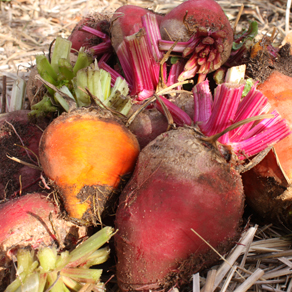
It might be time for an intervention. I planted another bed of garlic yesterday. It was a small bed, but just the same, I agreed to be done planting two weeks ago. My lunch is what got me into trouble. A quick meal of fusili tossed with the season’s final tray of roasted tomatoes, parmesan cheese, and a handful of garlic sautéed in butter. But it wasn’t just any garlic. It was a smooth Italian softneck that really shines as the star of simple pasta dishes. And for reasons I’m not at all certain of, I didn’t set much seed aside for my initial planting. Luckily I realized the error of my ways in the nick of time. I went out to the shed after lunch to rummage through our eating stock and found just enough plantable size cloves to put in a few rows. But that was it. No more. To distract myself from any further temptation, I devoted the rest of the afternoon to bringing in the last of the carrots, parsnips, potatoes, and beets.
This is the time of year when choosing between which of the root vegetables to prepare is still new and exciting. Young love. I treasure it, because I know the burden I’ll feel come February when I have to hack into yet another winter squash. But when that stage hits, I’ll turn to my garlic to help pull me through. Nothing dresses up baked squash, mashed potatoes, or roasted beets better than some caramelized garlic squeezed over the top. I just put a handful of peeled cloves in a little foil packet with some salt, pepper, and olive oil drizzled over the top and let them roast alongside the chosen accomplice. It seems to make everything more bearable.
Not that I wait around for the doldrums of winter to start roasting garlic, mind you. Fall officially kicks off around here with the first plate of roasted heads. The simplest method is to slowly roast whole heads in a 325º F oven until garlic is soft and aromatic – anywhere from forty five minutes to an hour depending on the garlic. The garlic will effortlessly squeeze out of its papers onto bread, pasta, crackers, baked potatoes and anything else you happen to have at the table. Prep for this is quick and easy – just thumb most of the outer papers off of whole heads, remove any dirt from the root end, and then use a sharp knife to trim the very tops of the bulbs off, leaving the tips of the cloves exposed. Put the heads in an appropriately sized oven proof dish with a lid (foil will do in a pinch), drizzle some good olive oil over the heads and sprinkle with coarse salt and pepper. It’s hard to go wrong.
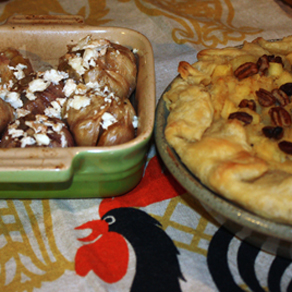
But sometimes I like to gussy it up a bit. This is how I served tonight’s garlic, with a humble parsnip pie to accompany it. A glass of Sangiovese, some Tetzner’s cinnamon ice cream for dessert, and our good friend Jim to share it all with made it a November meal to be proud of.
Fancy-Pants Baked Garlic
whole heads of garlic
butter
vegetable or chicken stock
wine (I prefer to use white, but since we rarely drink it, I often use red)
coarse salt
fresh ground pepper
bleu or feta cheese
Clean most of the outer papers off of how ever many whole heads you’d like to bake and trim away any dirt from the root end. Use a sharp knife to trim the very tops of the bulbs off, leaving the tips of the cloves exposed. Put the heads in an appropriately sized oven proof dish with a lid and add a little broth and a splash of wine. You want enough liquid in the dish so the heads are about half covered. Dot each head with a small pat of butter, and sprinkle with coarse salt and pepper. With the lid on, bake the garlic in a 325º F oven. As the garlic roasts, periodically baste the garlic heads, spooning the broth into the center of each head. When the garlic is soft and aromatic (about a forty five minutes to an hour depending on the garlic) remove from the oven and crumble a handful of good bleu or feta cheese over the heads. Replace the lid and let it sit for about 5 minutes. Serve the garlic, broth and all, with plenty of good crusty bread. Be sure to soak up some of the luscious broth along with the garlic. This makes a great appetizer or side for any fall or winter meal. Any left over heads (yeah, right) can be refrigerated and added to soups or sauces for extra flavor.

still space

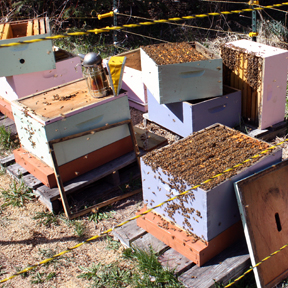
I suppose it’s time for me to introduce my girls. I have three hives of bees that I tend – all brimming with thousands of female worker bees and one queen. I’ll let you meet them in the order I typically work them. Freeda-b is the rockstar queen. My oldest queen by far, but you’d never guess it. She can easily outlay my other two more spry queens – filling each frame flawlessly with gorgeous brood. And her girls consistently make more honey than any hive I’ve ever kept. I’ve not ventured into the tricky art of raising queens, but Freeda-b is just the type who would lead me there. Her enthusiasm is contagious.

Next in line is Ruth Wilson (named after my great grandmother – not the English actress). Steadfast and sweet. I love her hive. Her bees remind me of the kid who really has to work at something to be good, you know the type – as opposed to the one equipped with all the natural talent and good looks to boot. Ruth Wilson also runs a “no attitude” ship. Her girls are a mild tempered and easy to work with – a treat really.

Which is pretty much the exact opposite of Valerie’s hive. I consider her my problem child. She is named in honor of Miracle Max’s wife. When I installed her into the hive as a young queen, I found my self asking “think it’ll work?” Which, to be fair, is a question I frequently ask myself in the bee yard, but this time the answer was clearly “it’d take a miracle.” Let’s just say the conditions were less than ideal, and there was a wee bit of mayhem going on. But she rallied and she seems committed to live up to her hard-knocks upbringing – her girls are SASSY. This was my first summer with her, but her crew has all the makings to be top-notch honey makers. I’m expecting great things from them next season, even if I have to put up with a little cheek.

But there is something else you should know about my hives. Bees make me nervous. They always have. Now, I’ve never been the flailing, squealing, swatting type around bees. I really want to like them. And I do. But they still make me jumpy. Every time I suit up to go out to the bee yard, my pulse increases and my body temp rises ever so slightly. Sometimes I even get the stomach flutters. That disconnect between instinct and rational thought is a fascinating one, isn’t it? But here’s the kicker. As soon as I am immersed with the girls – even the surly ones – my nerves settle and everything magically drops away. And I mean everything. For once, I don’t think about the work project sitting on my desk, or the potatoes that need to be dug before the ground freezes, or the phone call I should have made. I don’t replay any past conversations in my head, or dwell on what the future may or may not hold for me. Time stops and that’s all there is. Just bees. Not much else has this effect on me. I meditate daily, I practice yoga, I consciously relax. But for all my attempts at enlightenment, my mind still manages to have it’s fair share of private fracases.

I’m sure my motivation to set up a single hive five years ago had a lot to do with honey. But really I have come to see that luscious liquid gold as an added perk to a pursuit that finally gives me that sought after still space. My girls also manage to keep me endlessly curious  – if even slightly nervous. I love those sort of unexpected surprises that life dishes out.

carve-off twenty ten

My father took pumpkin carving seriously. From an early age, my brother and I were raised to give sincere contemplation to each year’s awaiting canvas. Sketches on paper, revisions if necessary – this was not something to be taken lightly. As we got older though, things started to get a little more competitive. Somewhere along the line “official judging” became an integral part of the process. My father frequently won. I remember the year he invited an outsider to judge – someone “impartial,” he said – wanting to claim his victory fair and square. And for a while, he had us, when his skinny oblong pumpkin with nothing but a single cyclops eyeball was crowned the winner. Only later did it slip that our guest was a minimalist architect – a fact that only our father was privy to.

He pulled plenty of other shenanigans – like disqualifying us for using “illegitimate” tools. He was a firm believer in carving with a standard chef’s knife. None of these fancy tools that come in pumpkin carving kits, no apple corer implements to make perfect circles, no x-acto knifes or special blades. My husband Mark is famous for the year he took his pumpkin out onto my parents’ front porch and, in an act of defiance, carved it up with his chainsaw. I think my father might have actually conceded the prize that year.

Yes – what started out as good old fashioned family pumpkin carving somehow became an institution that extended well beyond my youth. I even went so far as to send in my contenders via mail on the years I was far away from home. These days I carve in fond memory of my father, smiling with the knowledge that I am surely committing some violation that he can do nothing about.

On any given year, our garden usually yields about six to eight pumpkins. And even though there are only two of us, we seem compelled to carve every last one. We generally start a week or two before Halloween, and slowly stage a small welcoming committee outside the front door. And with the arrival of each new recruit comes a fresh bowl of seeds. I’m pretty sure that roasted pumpkin seeds would make my top 10 list of favorite things to eat.

Generally I soak them in a bowl of salt water – either over night or while we’re carving, depending on the timeframe. Then after draining them and drying them out a bit, I spread them on a baking sheet, drizzle some olive oil over them and add a hefty sprinkling of Penzey’s garlic salt before popping them in a low oven to roast for an hour or so until they are good and crunchy and nicely browned. Then, lookout. I have been known to eat an entire pan of seeds in one sitting. But last night, I decided to branch out. As I was rinsing the last of the pumpkin glop from the seeds, I happened to glance at a recipe for spiced pecans that I had clipped from the latest Bon Appétite to try, and I thought – why not? I tweaked it a bit – added some olive oil, reduced the sweet, and adjusted it to work with the seeds. The result was sort of a spicy pumpkin seed brittle. Very addictive, but a little more savory than my usual seeds. Which means I only ate about half of the pan in one sitting.


Spicy Pumpkin Seed Brittle

2 cups raw, cleaned, mostly dry, pumpkin seeds
1/3 cup honey
1 tablespoon olive oil
1 tablespoon sugar
1/4 – 1/2 teaspoon ground chipotle pepper

Heat the honey, oil, sugar and chili powder in a saucepan large enough to also hold the seeds. Warm the honey mixture, just until sugar and chipotle dissolve. Stir in the seeds, remove from heat, and stir well so all the seeds get nicely coated. Spread the seeds onto a baking sheet lined with parchment paper. Slow roast for about 2 hours in a 275º F oven, stirring every 30 minutes or so. When the seeds are done to your liking, remove from the oven and sprinkle with salt while still warm and sticky. As the seeds cool, they form a shinny brittle. After a few minutes, peel up the seeds with a spatula and roughly break them apart into a bowl. These would be great with pre-diner cocktails.

oh yes mustard!

I sent my husband out the door this morning with a shopping list that had a rough total of about $87. Eighty seven dollars worth of mustard, that is. Yes, mustard. He is going south to Milwaukee, which means he’ll pass through Madison, which means there is no excuse not to stop off at the National Mustard Museum in downtown Middelton. But I should back up. Until recently – say with the last six or so years – I have not particularly liked mustard. I always kept the obligatory jar of Dijon in the fridge for dressings and marinades, and when forced to, I’d eat it if it came pre-applied on a bratwurst, but really I went out of my way to avoid it. My childhood memory of that strange smelling, yellow sauce really stuck with me hard.

Enter Delouis Fils Dijon ‘a L’ancienne’.  Not coincidentally, about six years ago I was visiting my friend Laura who then lived in Mount Horeb, WI – the former home of the Mustard Museum. It turns out that there isn’t all that much to do in Mount Horeb, so a tour of the Mustard Museum made the cut. I must have been in a particularly open-minded mood because for whatever reason, I voluntarily chose, by my own free will, to taste mustard. Several of them. And one in particular – the Delouis Fils Dijon ‘a L’ancienne’ – won me over. I left with three jars of it. Its taste is smooth yet its texture rough – I suppose “grainy” is the technical term.  It isn’t sharp. It isn’t smelly. The flavors meld together and melt in your mouth. I didn’t know mustard could do that. Ever since then, my idea of a good lunch often involves a baguette, some good hard cheese, sliced onion and a jar of Delouis Fils Dijon ‘a L’ancienne’.

And evidently, that was my jumping off point. The list I handed over to Mark included three jars of my standby, two jars of Saucy Sisters Golden Honey Russian Mustard, a garlic mustard from Obester Winery, several jars of Dijon, and a new one that I’ve been dying to dip into  – Aunty Lilikoi’s Passion Habeñero Mustard. The name alone makes it a worth try, but something tells me the fruitiness of the passion flower combined with the heat of the habeñero will be stupendous as a salmon rub. Cell coverage was dicey when Mark checked in this afternoon, but I thought he mumbled something about an amazing new walnut Dijon to boot.

Rest assured I am not purchasing upward of a hundred dollars worth of mustard just for us. This trip is kicking off our holiday shopping – what Christmas stocking is complete without a little jar of pungent bliss? And those cute hexagon jars of spicy, Russian honey mustard make the perfect host/hostess gift. My go to appetizer in a pinch is thick Bavarian pretzels with a perky mustard. So you see, it’s good to have a few jars on hand.  All I can say is thank goodness  I’ve come to my senses. Literally, in this case. Luckily I seem to be making up for lost time just fine.

Here is my favorite mustard sauce to spread on salmon fillets about 10 – 15 minutes before grilling. I can’t wait to try it with the Aunty Lilikoi’s. I’ll let you know how it goes.

Mustard Sauce

Combine and heat gently:

1 tablespoon olive oil
1 tablespoon butter
1 tablespoon maple syrup
1 tablespoon honey
2 tablespoons soy sauce
3 tablespoons Dijon mustard
1 teaspoon minced garlic

tomato bliss

The garden has set  a new record. It’s the 24th of October and I’m still (gleefully) processing tomatoes. Canned, roasted, frozen, dried, you name it. I’d say I’m almost tired of them, but I know better than that. In the height of the tomato frenzy, my friend Michael came for cocktails, bearing with him our regular delivery of fresh goat cheese and milk. If I recall, that week’s delights included feta, chev, and queso fresco. Michael hand crafts these amazing cheeses with milk from his herd of 20 some dairy goats in Herbster, WI. I am plain giddy to have this incredible cheese and milk produced just up the shore from me. But, back to the tomatoes. Since September my kitchen has been a war zone of chili peppers, tomatoes, and tomatillos. So the rows of salsa laden jars lined up like soldiers and the pressure canner canner on the counter sparked an unusual cocktail conversation topic for us – botulism.

I love my Montgomery Wards, No 7-16 Magic Seal pressure cooker. I consider it one of my prized possessions – which I have my mother to thank for. She scooped it up for a song at an estate sale years ago. I’ve never been a fan of the vinegary tasting salsa that boiling hot water baths yield. Which is where my love affair with the Magic Seal comes in. It absolves my salsas of vinegar and lemon juice – and hopefully botulism. The problem is that it is nearly impossible to find salsa and chutney recipes developed specifically for pressure canning. Which has left me to crossing my fingers and winging it. Armed with the 1950’s era recipe book that came with my canner as my guide, I have created a handful of recipes that I feel fairly confident will not kill anyone. Still, Michael brought that little lingering question of doubt that lurks in the back of my mind to the forefront, forcing me to scour the internet once more for some “approved” pressure canning recipes. Turning up empty handed yet again, I put the latest batch of salsa away in the pantry with a slightly raised eyebrow. But they have to go somewhere, I rationalize.  I need the counter space for the next basket of tomatillos waiting to be turned into salsa verde.

My favorite, and less riskier way to make use of these late season tomatoes is roast them.

Slow Roasted Tomatoes

I cut the small to mid-size tomatoes in half and quarter the larger ones. I put them in a single layer, skin side down on a heavy baking sheet. I then drizzle them with olive oil, followed by a second drizzling of honey (probably a couple of tablespoons of each I’d guess). Topped with some sea salt, ground black pepper, and if I’m feeling really fancy, some fresh thyme leaves scatted about. Then I roast them pretty much all day in a preheated 200ºF oven. I check on them everyone and a while, but for the most part I just let them be. Once they look gooey and caramelized (anywhere form 4 to 8 hours) I take them out and let them cool before bagging them for the freezer. Not of course without eating several spoonfuls fresh. For an even more savory tomato treat, I accidentally discovered the merits of baking them on a roasting sheet that had previously cooked the Sunday morning bacon. Oh my. These gems got a special asterisks on the freezer bag and will be used to flavor rich soups and stews this winter. The rest of them will go on pizza, into sauces, or be eaten on a good chunk on bread with a smear of that delightful chev.

And although it is probably a little late in this year’s season for canning, here are two salsa recipes – one tomato based and the other a tomatillo hot sauce – that I have made and pressure canned (without incident!) for years. But since I am not a USDA food science specialist, and nor can I find any concrete information to back up my recipes, I can’t in good conscious tell you to do the same. I can say however, that these are perfectly safe for the freezer! But for those of you with pressure canners who know what you are doing, I’ll just mutter under my breath 15 minutes at 10 PSI. I stress that any sort of canning (hot water bath or pressure) is not something to take lightly. Being quick, sterile and conscientious is critical at every step. Don’t mess around. Period. I highly recommend investing in a copy of the Ball Blue Book – a thick magazine like book available for about 8 bucks. In addition to loads of recipes it has very thorough instructions for both hot-water and pressure canning.

Thirteen Pepper (plus one more) Salsa

10 pounds of high quality tomatoes
1 pound onions
3 tablespoons salt
13 serrano peppers
1 small habeñero pepper
1 bunch cilantro, rinsed and dried

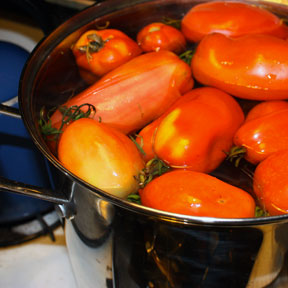
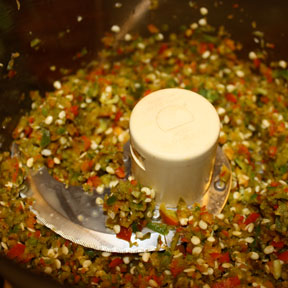
Bring a large stock pot of water to boil. Carefully drop in the tomatoes and let simmer for about a minute. Pour off water and let the tomatoes cool until you can comfortably handle them. Slip off their skins, remove any core and cut the tomatoes into fairly large chunks. I do this right over a colander so any excess seeds and juice drain away. As the colander fills up, drain off as much juice as you can and empty the tomatoes into your cooking pot (I use a stainless 6 quart). Once all the tomatoes are chopped and in the pan get them simmering gently, stirring occasionally. Meanwhile, chop the onions and add to the tomatoes along with the slat. Continue to let everything gently simmer, stirring occasionally. I use my trusty Cuisanart food processor to chop my peppers. I remove the stem with a knife and roughly chop them before whizzing them up – seeds and all. If you prefer a more mild salsa, you might want to remove the seeds and ribs from some or all of the peppers and omit the habeñero. I would recommend donning gloves for this job. Pulse the peppers to your desired size. A spoonful of tomatoes from the pot will help this process if you want to get the pepper chunks particularly small. Add the peppers and chopped onions to the tomatoes and simmer until you reach your desired consistency. Depending on how much time I have I will sometimes cook them down a bit for a thicker salsa, or, if I am short on time, I settle for a slightly thinner salsa. Both have their merits. Bring the mixture to a good boil and stir in the chopped cilantro just before putting it in jars (or freezer bags). Yields about 6 to 7 pints, depending on how far you cooked it down)

Dragon’s Milk Hot Sauce
(also known as “AH·HOO·AH” Sauce – a sound that my father coined and is often times involuntarily emitted through one’s lips after eating)

3 pounds high quality tomatillos
2 – 3 medium onions
4-6 cloves garlic
1 small organic lime (juice and zest)
15 hot peppers (I use a variety – jalepeños, orange thai, chillipeños, hot wax, etc.)
5 – 25 habeñeros
1 tablespoon salt

Peel the husks from the tomatillos and arrange them in a single layer on one or two baking sheets. Roast them in a preheated oven at 325ºF for about 25 minutes. I like them oozy and a little bit charred here and there.While the tomatillos roast, you can begin preparing the peppers. (Again, remove the seeds and ribs if you like, but bare in mind that you are making hot sauce after all). Using a food processor or blender, whiz the garlic, lime juice, lime zest, and peppers together. You can also puree the onions in this mixture, but I prefer larger pieces of onion in the finished sauce, so I add them directly to the cooking pot. Once the tomatillos are roasted you can begin dropping them into the puree and pulsing to your desired consistency. I like a fairly smooth hot sauce. The tomatillos will be hot and juicy, so take care not to get spattered. Start transferring the mixture to your cooking pot (I use a stainless 6 quart) when the processor gets full. Once everything is processed to your liking and all in the cooking pot, bring it to a simmer. Add the onions if you haven’t done so already. Bring it to a nice hot boil before jarring (or freezing). Yields about 5 to 6 half pints (since this is hotter and people generally tend to use less of it, I preserve it in smaller portions)

* You can also turn this into a more mild mannered tomatillo salsa by cutting way back on the hot peppers. I think the habeñeros contribute the best flavor, so I would use 4 or 5 seeded peppers total.

bring it!

One has to admire the sturdiness of a garlic clove. That it prefers to spend its winter wrapped in a shall of frozen soil is beyond my line of thinking. Why not hang out in the dark cool pantry for the winter months and bide yourself some time? I could plant you in the spring – on one of those glorious drippy late March days. But with the exception of only the smallest cloves, anything lingering past February is generally a sad shriveled site.

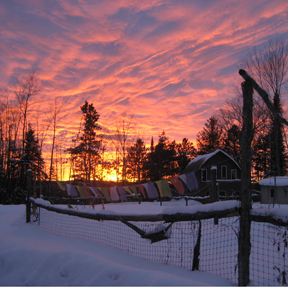
I’ve always considered myself a winter person. Sort of. I ski. I walk the dog. When the snow is right I populate the garden that I know is under there somewhere with snowmen. I do my best to get out. Some of the most spectacularly stunning days occur in winter. And the January sunsets off our western ridge typically set the sky aflame.

But to say I wrestle with the cold is putting it gently. I’m cursed with poor circulation. This past August I stood in front of an infrared camera on a 90 degree day and the large screen it was projecting onto turned a remarkable shade of blue. So on these fall mornings when my bare feet go numb after even the shortest of journeys outside, I literally cringe at the thought of the ensuing winter.

But these are also the days where the mid-day sun warms the soil up just enough to tease me back outside. I’ll just put in one more row, I reason. After all, if a 2 inch clove of garlic can bare the brunt of our Wisconsin winter, then so can I. “Bring it!” I say – as I march triumphantly inside to warm up by the wood stove.


instapig

No Instagram images were found.