Archive Page 12

shake it up

My grandpa Orville was a genuine, kind-hearted Swede who spent the bulk of his days on a tractor in Lafayette, MN – a small farming community in the south central part of the state. My brother and I would often travel via Greyhound bus from big city Saint Paul to spend stretches of our childhood summers with our maternal grandparents – Orville and Myrtle Swenson. The bus deposited us at Lyle’s Cafe in Winthrop (the next town north) where grandpa would be waiting to fetch in his Mercury. Then, luggage stowed in the trunk, Mister-Misty from the Dairy Queen in hand, off we’d go, barreling down Highway 15 – much like falling through the rabbit hole into another world. I couldn’t soak up rural, small-town life fast enough.

Upon arrival in Lafayette, the very first thing grandma would do is give my brother and me enough money so we could each go buy our very own box of sugar cereal for the coming days ahead. I still don’t know if my mom was privy to this arrangement, but I do know she wouldn’t have approved of it. We never got sugar cereal at home. Instead we got things like homemade granola, shredded wheat, and maybe if we were lucky, plain cheeriros.

Giddy with anticipation, my brother and I would trek the three blocks to Malmberg’s Store and spend an inordinate amount of time perusing the cereal aisle. Even though I knew what I wanted before I set foot across the threshold, I still felt compelled to check out all of my options. Then, armed with my very own box of Peanut Butter Cap’n Crunch that I wasn’t even required to share with my big brother, I’d go up to the counter to make my purchase. Inevitably, the clerk would eye me up and say “You must be Mary’s girl.” How could she possibly know this, I’d think? How does she even know who my mom is? But I’d smile and nod yes in amazement.

Thinking back on these visits, what I remember most (cereal aside) is the food. In particular, I was strangely fascinated with watching my grandpa eat. Three times a day, like clock-work, he’d sit down at the head of their big rectangle, vinyl clad, table and wholeheartedly indulge in whatever was put before him. It was so foreign to me. This man wasn’t just eating, he was literally fueling up for the physical demands that lay ahead of him.
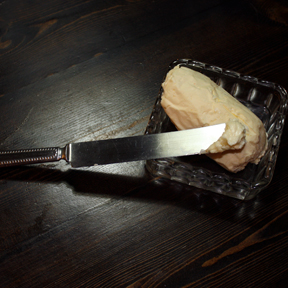
From my pre-teen perspective, my grandpa was a man of simple culinary pleasures. But reflecting on this as an adult, I’d say his indulgences were well chosen. Funny that I seem to have adopted most of them (save his annual lutefisk and blood sausage feast). I’ve already shared our mutual fondness of popcorn. And it’s my grandpa I credit for my love of a plain piece of bread slathered in butter and honey. The key word here is the slathered. His table knives, several of which now reside in my silverware bin, have wide, flat blades made for spreading – not cutting. The more butter the better was his motto. Knowing this now only makes me wish I knew him better.

And then, there was the ice cream and the malts. Ice cream (at least when I was visiting) was a nightly staple for Orville – which you’d never guess, given his slim build. Now ice cream was as rare of a treat in our house as was sugar cereal. But my father always told me “when in Rome, do as the Romans do.” And so I dutifully ate ice cream with my grandpa. Plain vanilla with Hershey’s chocolate syrup is what I remember best. Sometimes in a bowl, sometime shaken up with a spoonful of malt powder in his tin malt cup.

I had nearly forgotten about this fine, non-motorized invention until one night several years ago on a visit to my mom’s. We were standing talking in the kitchen when she unexpectedly reached up to one of the top shelves and handed over her dad’s Carnation Malted Milk shaker for me to have. “Really?” I asked, stuffing it in my bag before she had time to reconsider.

I think Orville would be pleased as all get out to know that his beat up old malt cup is now one of my prized possessions. I have spent many a night combining flavors in search of the perfect malt. And though I’ve tried some wild things, I have to admit that plain old vanilla ice cream, a splash of milk, some Hershey’s, and a spoonful malt powder is hard to beat. But then the other night, I shook up a very simple malt that I have been craving ever since. I happened to have some homemade honey-cardamom ice cream on hand (recipe below), but I think you could make these just as well with vanilla ice cream, an extra spoonful of honey, and dash of some warming spice. Nutmeg, cardamom, mace, or cinnamon all sound fabulous. Just a subtle hint of one of those flavors combined with the honey and vanilla would be spot on. I also can’t wait to try this later in the summer with a handful of fresh blueberries tossed in.

Honey Malteds

3 small scoops slightly melty vanilla ice cream
3/4 cup milk
2 rounded tablespoons malt powder
1/2 teaspoon vanilla
1-2 tablespoons honey (I used 1 T with the honey ice cream)
small dash of nutmeg, cinnamon, cardamom or mace

Shake up in a malt cup, or pulse lightly in a blender. Pour into chilled glass, adorn with a cheerful straw and enjoy. Makes one 10 oz malted.

Honey-Cardamom Ice Cream
Adapted from Alice Medrich’s Pure Dessert

I’ve also made this plain with no spice and love it. Adding a pinch of nutmeg instead of the cardamom is another favorite combo. It’s a wonderful light tasting ice cream.

1/2 cup whole milk
1/3 – 1/2 cup mild flavored honey
Rounded 1/8 tsp. salt
2 1/4 cups heavy cream
1/8 – 1/4 teaspoon cardamom (to taste)

In a small saucepan, warm the milk over medium heat until it begins to simmer gently around the edges. Pour it into a medium bowl, and allow to cool completely. Add the honey and salt, and stir well to dissolve the honey. Stir in the cream and cardamom. Taste, and adjust the amount of honey and spice as needed. Cover and chill thoroughly, preferably overnight.

Freeze according to the instructions for your ice cream maker. Freeze the ice cream in the freezer until hard enough to scoop, at least 3 to 4 hours.

pig pen

Six years ago, my good friend Julie – who also happens to be the closet thing I have to an office mate – gave me a pen. But it wasn’t just any pen. It was an ACME pen. “It’ll change the way you write,” she said. “You’ll get excited to pay the bills with it.” And indeed, it is an outstanding tool. It’s got so many great attributes, I don’t know where to start. First off, it’s bright. And happy. It’s a bold yellow-lime color with abstract little shapes in it. And it’s hefty – solid and well built. The weight of it is comforting. It’s a rollerball pen and it writes like a dream. So smooth that you want to keep writing just to maintain the glide. And then there’s the fact that it was a surprise gift from a friend. Everything about my pen makes me feel good.
This particular pen, which is simply named “lime” was designed by Karim Rashid. I went online to look him up shortly after I got it. According to the ACME website, Rashid is “a leading figure in the fields of product, furniture and interior design and is largely credited for bringing exceptional, affordable design to the masses via iconic products like the Oh Chair and Garbo Trashcan.”
My pen has sort of become like an adult security blanket. I take it everywhere. Even when I’m fairly certain I’m not going to be required to write anything. Because you just never know. I don’t misplace it very often, but occasionally it happens. It’ll hide out in the bottom of my bag, or get lost in the couch cushions. It always surfaces, but I have been late to meetings looking for it. If it goes off missing for more than a day or two, I’ll e-mail Julie in a panic. I tell her that I feel nervous without it. She calms me down and assures me it will turn up. And she’s always right.
But then, last week, something terrible happened. My pen broke. Like really broke. I took it out of my coat pocket and when I removed the cover, the bottom half of the pen stayed stuck inside. This had never happened before. It was so stuck that I couldn’t even get the top and bottom screwed together again. This was serious. I gently tried to pry it out. No luck. So I tapped it on the desk. Again, nothing. And then, after a few more taps, the decorative metal cap topper flew off, the clip went scattering across the floor, and the metal chamber along with a plastic interior liner tumbled out before me. The plastic piece was cracked. I screwed the top and bottom together again, but every time I took the cap off, the little plastic liner piece came out attached to the writing tip. And there seemed to be no way to reattach the metal top or clip. I had to walk away.
I e-mailed Julie right away. She’d understand. Then, being it was 5:05 pm on Friday, I went to weep over a beer. I learned from the ACME website that my pen is no longer under warranty. But for $11.95 I can send it in for repair – or if it’s terminal, replacement. This seemed like a fair enough deal. But I wasn’t emotionally prepared to ship it off. The pieces of my pen sat pathetically on my desk for a few days until I mustered the courage to package it up and send it on its way to Hawaii, back to the motherland, for consultation with the good folks at ACME.
In the meantime, I have resorted to a plain-jane Parker pen that I took up with during my freshman year of college. It’s an old friend for sure. But now it feels awkward in my hand – too slender and light. Its navy and metal color combo is classy, but far from cheerful. And while it gets the job done, its no rollerball. Nevertheless, I sit and doodle with it, making loopy curlycues, and big block letters while I anxiously await any news from Hawaii of my trusted pig pen.

emergency tonic

My mom had an emergency appendectomy last week. Is there any other kind, really? My appendix decided to cash things in when I was seventeen. And it too was an emergency. In retrospect, the real emergency came several days after surgery. I was sent home to recover, but I never did. I have a vague memory of dad slinging me over his shoulder in a fireman’s carry and laying me into the back seat of the family toyota for a run to the emergency room. The details from there on out are sketchy at best. Being force fed what seemed like a considerable amount of chalky, white, nauseating barium is the only thing that really stands out. The rest is all hearsay. My intestine had twisted over on itself and to complicate matters, it had leaked. Infection was raging. A second surgery was ordered.

Evidently the prognosis was dire. Dire enough that my dad felt compelled to smuggle our family cat, Max, into St. Paul Ramsey Hospital. Here was a man who didn’t mess around. He knew just how to get to the core of things. He drove Max downtown, stuffed him into a soft sided brief case, rode up several flights in the elevator, and waltzed into my room. They didn’t stay long, but long enough. Somehow I managed to pull things off. Or rather my surgeon managed. I spent another solid week in the hospital, but eventually I got home. Home to Max. Home to my parents who nursed me back to life.

Needless to say, I was glad to learn of the tremendous technological strides that have been made in the world of appendectomies in the last 20 years. Three cheers for laparoscopic surgery. But medical advancements or not, I went to help my mom recover. She’s always been tough, and this was no exception. Her sturdy farm-girl roots shinned from the get-go. The surgeon made her promise to at least fill the pain prescription. She did, but the bottle sat in the bathroom, unopened. She was in and out of the hospital in under 24 hours. And once I got her home and settled in, I proceeded to do what seems to me like the obvious thing to do in almost any situation – I cooked.

I made silky parmesan risotto with mushrooms, creamy macaroni and cheese soup with roasted tomatoes on top, and a ginger chicken soup. I think everyone should have a reliable, cure-all soup recipe in their back pocket to pull out in times of need. And this is my new standby. It’s flavor is very grown up – not like any other chicken soup I have tasted. The broth is beautifully clear and infused with ginger. The chicken itself comes out amazingly tender and packed with the rich flavor of the broth. I know this is a tonic I will crave the next time I’m under the weather.

This recipe originated from Nina Simond’s A Spoonful of Ginger, but I found it in the Essential New York Times Cookbook. Hesser’s version calls for Shaoxing rice wine, which I didn’t have, so I subsistuted sake – and would do so again. I loved the flavor. Depending on the situation, I can see serving just the broth by itself or with the chicken loosely shredded into the soup, which is what my mom and I did. There was plenty of left over chicken for other uses. In fact my mom told me tonight that she ate the last of it in a kung pao chicken.

Clear Steamed Chicken Soup
Adapted from the Essential New York Times Cookbook

One 3 1/2 pound chicken cut into 10 pieces, trimmed
(I opted to remove a good deal of the skin, but left some in tact for flavor)
1 3/4 cups sake
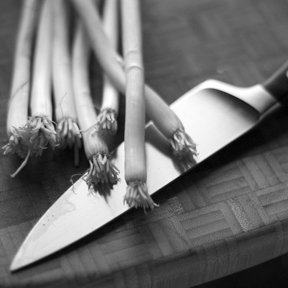
10 scallions, trimmed and smashed gently with the flat blade of a knife
12 quarter-sized discs of fresh ginger, smashed with the flat blade of a knife
6 cups boiling water
1 teaspoon salt
Chopped scallions for garnish

Heat the oven to 425ºF. Fill a pot large enough to hold all of the chicken pieces with water and bring to a boil. Blanch the chicken pieces for one minute and drain.

Combine the everything but the salt in a Dutch oven or casserole with an oven prof lid. Cover tightly with aluminum foil, then place the lid on top. Pour an inch or two of boiling water into a roasting pan that is large enough to hold the pot of chicken. Place the pot of chicken in the hot water bath and put the whole shebang in the oven for 2 hours. Check the water level in the roasting pan and replenish with more boiling water if necessary.

Once the soup is out of the oven, skim the top to remove the fat. Remove the scallions and ginger. Add salt and adjust to taste.

Add a handful of loosely shredded chicken to each bowl. Serve the hot broth sprinkled with scallions.

project picnic

My sweetie and I have never really gotten into giving gifts on Valentine’s Day. We exchange valentines for sure – Mark has won my heart with his brown paper bag valentines dressed up with nothing more than a sharpie. Truthfully I think the first year he made that style he was in a pinch and managed to pull off something quick. But it was charming. So much so that now I’ve come to love and expect them. This year he went all out. He found the stash of construction paper at school.

I almost always make a plate of pretty pink cut-out cookies. Or sometimes a tray of coconut cupcakes dotted with tacky conversation hearts. If the ice road over to Madeline Island has formed by the 14th, we’ll set out for one of our favorite restaurants, Lotta’s, for a deliciously romantic meal. But we’re just as happy to stay in, cook something simple, and light a few candles. As it happens this year, the ice road was open, but Lotta’s was not. So instead, I made Cacio e Pepe and served it in cute little baked parmesan bowls. A spinach salad with chopped egg and a tangy lemon mustard vinaigrette, a bottle of wine, and we were all set. It was a photo worthy meal, but in an effort to be the teeniest bit romantic, I refrained from bringing my camera to the table. I snuck back later and took a dessert shot instead.

But this year, there was something else at the table. A present for Mark. Curiously, it’s something that I have longed after for a long time. A good old-fashioned picnic basket. I love picnicking. What can top finding a few new salads to try out, rounding up some good cheese and fancy snacks, packing a blanket, a fresh magazine – or maybe the Sunday crossword, and heading somewhere outdoors to take the afternoon off? It’s something we don’t do nearly enough of.

In an effort to inspire us, I found an old metal picnic tote on Etsy. I outfitted it with enameled plates, bistro-style tin wine glasses, outrageously miniature salt and pepper shakers, stripey napkins, and some odds and end silverware. I also threw in a book of Pablo Neruda love poems. Then I made 12 cut out hearts, each with a different picnic destination on it – one a month. Seems like a reasonable goal, doesn’t it? My proposed settings range all over – from Potato River Falls (where you can lounge about in waterfall filled pools), to the top of Mt. Ashwabay (our local ski hill that has a stellar view of Lake Superior), to my mom’s cherry orchard, to our living room floor (I figure we might need an inclement weather back-up).

I agree with Alice Waters’ in her Art of Simple Food when she claims our taste buds are enlivened in the open air. And who out there couldn’t use a little more R&R and change of pace in their routines? I for one am looking forward to reviving the fine art of picnicking. I can’t wait to round up and create some picnic worthy recipes to share with you as we take our monthly adventures. I welcome anyone who wants to join me on project picnic and share their experiences. I’d also love to hear any good local picnic destinations if something comes to mind!

switching gears

I had my first Dark Days cooking flop of the challenge last week. I’ve been struggling to come up with a few more vegetarian options for our 50-mile radius meals. Don’t get me wrong, I love our local meat. I feel so lucky to have a freezer full of pork, chicken, beef, lamb, and bison – all raised by people I know, trust, and respect. But it seems like most of our weekly Dark Days meals are meat-centric. And as a former vegetarian, I still harbor a penchant for meatless chow. The DD challenge has got me realizing that with the exception of wheat, we don’t really have anyone in our neighborhood producing dry beans or other grains.

With that in mind I decided I had better embrace the one grain I can get locally. I set out to create a hearty wheat berry salad. Picture roasted pumpkin cubes dressed in maple syrup with pinches of cardamon and cinnamon. Mix in some garlic sautéed in saffron butter, toss with the warm wheat that has been simmering in homemade veggie stock all day, and top it off with a heap of caramelized onions. Oh, and maybe add a few little smudges of local chev to each bowl before serving. I was feeling pretty cozy just dreaming it up.
In an effort to try something extra good for us, I decided to sprout my wheat berries a few days before making the salad. According to Sally Fallon – who has yet to steer me wrong – spouted grains and seeds are substantially healthier for us. In her book Nourishing Traditions, she says that the process of germination produces vitamin C, increase vitamin B content, and can raise the carotene level up to eight times that of unsprouted grain. Reading this bit of news really got me going. It’s the middle of February in northern Wisconsin, bring on the carotene! Fallon goes on to explain that even more importantly, sprouting neutralizes the phytic acid found in the bran of all grains which inhibits the absorption of all sorts of good minerals (calcium, magnesium, iron, coper, and zinc). And if that’s not enough, she also tells us that the spouting process creates a number of good digestive enzymes. What’s to lose, I think?
I soaked my canning jar of wheat berries over night, drained them in the morning, and proceeded to tend them diligently for the next 2 days. Which basically meant giving them a rinse a few times a day and turing the screen lidded jar back upside down to drain and breathe. Extra health benefits or not, it was absolutely thrilling to have something living and growing in the kitchen windowsill. And perhaps my zealous green thumb is what got me into trouble. I think I over sprouted.
I refrigerated the sprouts after just 2 days, even though the instructions said it would take 3 or 4. In retrospect, they did seem a little lanky, but when it came time for Dark Days Meal 10, I proceeded as planned and followed Fallon’s cooking instructions of a slow oven simmer. All afternoon a cross between the smell of freshly baked bread and simmering stew wafted up the stairs to my office. When I couldn’t stand it any longer, I went down to taste the wheat. Here’s where the trouble started. The flavor was good, but the texture was chewy. I mean really chewy. No amount of masticating seemed to break down the sprouted ends of the wheat. Maybe it was just me, I thought, and hopefully returned the pot to the oven. But when Mark got home from work, I did the ultimate test. I gave the man who will eat nearly anything without complaint a bite and waited for his reaction. He was nice enough about it, but I knew I was going to have to switch gears for Meal 10.
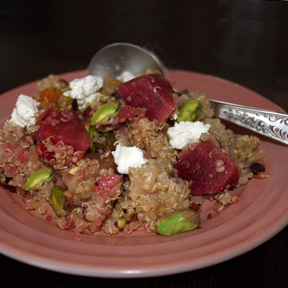
We were down to the wire on time and I need something quick. So I made the culinary leap from Maple Hill Road in Washburn, WI all the way to South America and grabbed one of my favorite grains off the pantry shelf – quinoa. It’s light, it’s fluffy, it’s nutty, it cooks up in 20 minutes. Perfect. Except suddenly my sweet pumpkin, garlic, and caramelized onion concoction seemed too heavy. I had also roasted a tray of beets that afternoon, which were now quietly resting in a splash of olive oil and red wine vinegar. These seemed like a better fit. With the exception of the quinoa, I kept things mostly local, but I did get a little carried away with the dressing. Since I had to leave my big, bold pumpkin behind, I comforted myself with something tangier and more perky. Which means I added lemon juice and fresh ginger to the dressing. And then, at the last second, I couldn’t resist tossing on a few bright green pistachios that I had on hand. Just the sight of them mingled with the pink beets made me a little less glum about my sprouted wheat debacle.
I still plan to try my “pumpkin berry” salad and will even give the carotene packed sprouted wheat a second chance. I checked back and Fallon does say not to let the sprouts get beyond 1/4 inch. So I’m guessing that’s where I went wrong.
I felt like I should have jumped right back on the indigenous horse and done something particularly noteworthy for Dark Days Meal 11, but Mark and I were both rebounding from mid-winter colds. We were tired and unenthusiastic. Nothing sounded better than a plate of blueberry waffles with a side of thick, Hermit Creek Farm bacon. Even though I had local flour and milk on hand, I was feeling so lazy that I opted for the jar of Sturdiwheat pancake & waffle mix from the pantry – which is actually somewhat local, especially coming from my mom, who lives just down the road from Red Wing, MN where it is made. And I have to say that the mix beats out many of the recipes I have made from scratch. Sturdiwheat blends some of the outer wheat bran back into the mix, which yields an especially flavorful waffle. To make us feel even better, I served them on my grandma’s prettiest flowered plates.
Dark Days m.10
Not Really Local Warm Beet Salad
Beets and shallots (cold storage, via our garden), chev cheese (Sassy Nanny, 30 miles), quinoa (most likely South America), olive oil, ginger, lemon juice and coriander.
For the beets:
Wash and trim one pound of beets. Leave part of the top and skin intact. Put whole beets in a covered baking dish, adding enough water to cover the bottom of the dish to about 1/8th inch. Cover and bake in a 350º F oven until beets are tender – about 45 minutes to an hour. Uncover, cool, cut off what is left off the tops and slip off skins. Cut bets into wedges or cubes and sprinkle with 1 teaspoon of red wine vinegar and a dash of salt. Let stand a bit and then toss with about 2 teaspoons of olive oil.

For the quinoa:
Bring 1 cup quinoa and 2 cups water to a boil, reduce heat, cover, and simmer about 20 minutes until water is gone and quinoa is tender. Set aside.

For dressing whisk together:

2 tablespoons olive oil
2 tablespoons fresh lemon juice
1/2 teaspoon ground coriander
1 teaspoon fresh grated ginger
2 tablespoons finely minced shallots

In a large bowl, stir together the quinoa and beets, pour dressing over stir to combine. Sprinkle with toasted pistachios and crumbled goat cheese.

Dark Days m.11
Waffles for the Queen of Heaven
Sturdiwheat (Red Wing, MN, 208 miles – or 18 miles for my mom), blueberries (Blue Vista Farm, 2 miles), yogurt and cultured buttered (homemade from Tezner’s milk and cream, 15 miles) maple syrup (Andy and Linda’s sugarbush 19 miles), bacon (Hermit Creek Farm, 29 miles). 

Top piping hot waffles with butter, yogurt, blueberries, and maple syrup.

take out a chicken

I got the very best sort of e-mail from my husband Mark last week. The subject line said “take out a chicken.” The body contained just a link. I clicked it, gave it the once over, and eagerly proceeded to the freezer to pull out one of our Pasture Perfect Poultry chickens (of which I can’t speak highly enough – and I am not an overly huge fan of chicken). And then I waited for it to thaw. Finally, on Thursday evening, I had Mark do the dirty work of piecing up the chicken while I got the marinade ready for an overnight soak.

It felt like Friday night would never come. But five o’clock eventually rolled around and I took the opportunity to mix us a couple of my favorite winter time cocktails – a shot of Sailor Jerry’s mixed with grapefruit juice and a splash of soda. And then we got to work – if you can even call it that. We simmered the chicken in the same pot that it had been marinating in. While it cooked, we put on a pot of jasmine rice and rustled some Valentine green beans out of the deep freeze. We left things to simmer while we sipped our drinks and reflected on what felt like a very long week. (I even used our titanic ice cubes. Having little ice bergs float in my drink and watching the big ship slowly go down is a sure way to cheer me up.)

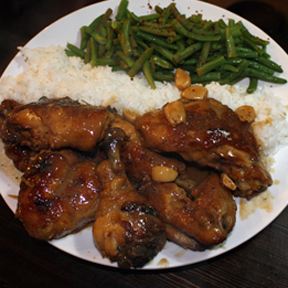
And thirty minutes later things were indeed looking up (ice cubes aside). We sat down to a steaming hot platter of Chicken Adobo. It looked heavenly and smelled even better. It’s a good thing we did our chit-chatting over cocktails, because conversation rapidly died off when we picked up our forks. At some point I did mutter that the recipe reaffirms my belief that anything involving a can of coconut milk is bound to be good. We did give the chicken a quick spin in the broiler while the marinade reduced – which I highly recommend. It caramelized and crisped up the chicken just perfectly. The sauce meanwhile, was creamy, slightly tangy, and loaded with flavor. And the tender, coconut milk simmered garlic cloves were outta this world.

I only have one piece of advice to offer on this bitterly cold Wednesday afternoon. Take out a chicken.

Chicken Adobo
(Adapted from the Purple Yam’s Memories of Philippine Kitchens)

Marinade:
2 cups coconut vinegar
(or rice vinegar, but I would add an extra 1/4 cup, as it is less tangy than coconut vinegar)
2 cups coconut milk
1/3 cup soy sauce
20 garlic cloves, peeled (the more the merrier – you won’t regret it)
4 bay leaves
5 whole birdseye chiles (the cutest little chiles I’ve ever laid eyes on)
2 teaspoons freshly ground black pepper

One (5-6 pound) whole chicken, quartered, and cut into pieces

Combine all of the marinade ingredients – ideally in a stainless or enamel pot with a lid that is large enough to hold the chicken pieces.. Add the chicken pieces and turn to coat in the marinade. Refrigerate for at least 2 hours, or overnight. If the pieces are not completely submersed, flip them once or twice throughout the day.

Heat the chicken and the marinade over high heat. Bring to a boil, then reduce the heat and simmer, stirring occasionally to make sure the chicken is covered in the marinade, until the chicken is cooked through and tender, 20 to 25 minutes.

Transfer the chicken pieces to a broiler pan and broil for about 4-5 minutes. Flip the pieces, spoon a little marinade over them and return to the broiler for another few minutes, While the chicken is broiling, raise the heat under the marinade pan to medium-high, and reduce the sauce until it is the consistency of heavy cream, about 10 minutes. Remove the bay leaves and chiles. Return the now lightly browned chicken to the sauce and cook until just warmed through.

noodle wonder

I know I said I have the southern cooking bug, and I do. I even made a trip to Sixth Street Market this week (a gem of a butcher shop that northern Wisconsin is lucky to have) and got some gorgeous shrimp so I could try my hand at Shrimp and Grits. But then, I got seriously sidetracked. I shamelessly used my southern bound shrimp for a dish I can never resist – Pad Thai.

Often thought of as one of Thailand’s national meals, Pad Thai is a relatively simple noodle dish that has the perfect blend of sweet, sour, savory, slight saltiness, and varying degrees of spiciness. It’s my go to order when I find myself in an Thai restaurant. It can vary widely from chef to chef, and while I’ve had some that I like better than others, I’ve yet to dive into a bowl of Pad Thai that I haven’t thoroughly enjoyed. It’s hard to screw up stir fried noodles.

Many years ago, my dad gave me a slim little book called Seven Wonders: Everyday Things for a Healthier Planet. After an honest introduction that leaves you feeling pretty much disgusted to be a part of the over indulgent American society, author John Ryan goes on to list seven forward thinking tools to help us reduce our ecological wear and tear on the planet. Unlike most American consumption habits, Ryan’s theory is that these seven items can be used by everyone on Earth without overtaxing our planet’s resources. Ryan proposes that the world as whole should make better use of the following items: the bicycle, the clothesline, the condom, the ceiling fan, the public library, the ladybug, and – of all things – Pad Thai.

Ryan reasons that Pad Thai is a sustainable wonder because, like a lot of Asian food, it consists mainly of rice noodles and vegetables – which is friendlier on the planet and our bodies than the typical meat based American meal. In general he encourages us to eat more plant and grain based meals and less meat (particularly grain-fed meat). He cites plenty of other other ethnic cuisines that environmentally beat out the majority of American fare – Italian based pasta dishes, South America’s heavy use of corn, quinoa, and other grains, and Asian inspired rice meals. But I think his decision to highlight Pad Thai as a leading example of sustainability is a splendid one. It’s hard to find a more flavorful dish.

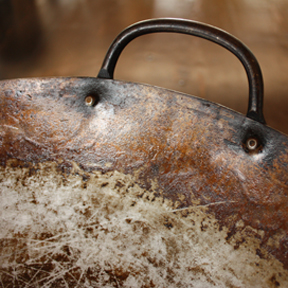
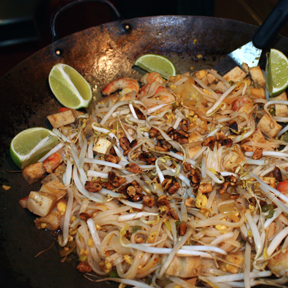
I’ve tried handfuls of Pad Thai recipes over the years – even one from my favorite, but now sadly defunct, Thai restaurant in Saint Paul (White Lily). But I keep coming back to a recipe that I clipped years ago from the back of a package of rice noodles as my home base. (In my book, packaging recipes are a valuable source that should never be overlooked!) As if saving the planet isn’t enough, the other  brilliant aspect of Pad Thai is that it’s quick. I can have it on the table, chopsticks at the ready in under a half hour. Whats more, I get to use my hand hammered wok – one of my favorite pieces of cookware.

What I put into my Pad Thai tends to vary depending on what I have on hand. Rice noodles, eggs, bean sprouts, and the sauce are pretty much the only constants. I almost always use tofu and in the summer I am prone to toss in a big handful of broccoli or cabbage. I rarely use other meat or shrimp, but once I got my grits designated shrimp home, I couldn’t resist making an extra special Pad Thai. Luckily, I can rest easy knowing that when I do get around to those Shrimp and Grits, I’ll be eating another earth-friendly, grain-based meal (shrimps aside of course).


Pad Thai
Honey-roasted chili peanuts
I generally start by throwing about 1/2 cup of raw peanuts into a hot, peanut-oiled wok with a little garlic, salt, and dried chili pepper tossed in. I stir fry these over medium-low heat until they are toasty and fragrant. Then I drizzle a little honey over them and remove them to a plate to get cool and crunchy. Raw or plain roasted peanuts will do in a pinch, but I think it’s worth the extra effort in the end.

Noodles
Cook 8-10 ounces rice noodles according to the package directions, drain and rinse with cool water. Keep these handy next to your wok.

While the noodles cook, mix together the sauce in a small bowl or measuring cup.

Sauce
1/4 cup rice vinegar
2 tablespoons Thai fish sauce
2 tablespoons hot chili sauce (I’m partial to sriracha)
2 tablespoons liquid honey
2 teaspoons tamarind paste (a nice addition, but not completely necessary)

Everything else (vary as desired)
I like to get everything chopped and at the ready before I heat up the wok.

2-3 tablespoons of minced garlic
3 scallions, sliced
12 medium shrimp, peeled and deveined
4 ounces of tofu* (or cooked chicken, pork, etc) diced or shredded
Handful of chopped broccoli, cauliflower, cabbage etc (optional)
2 eggs, lightly beaten in small dish
1 tablespoon pickled radish, thinly sliced (optional, but really tasty)
2 cups bean sprouts
1 lime, cut into wedges
Roasted peanuts
Red peper chili flakes

Heat wok (or large skillet) over medium heat and coat generously with 1 or 2 tablespoons of peanut oil. Add the minced garlic and saute briefly. After a few minutes, add in the egg and place the shrimps around them. Stir continuously until the eggs start to firm up. Add in the scallions and  (if using) the broccoli. Stir fry 3 to 4 more minutes until the shrimp are pink. Toss in the tofu and radishes and stir fry a few times to mix. Add in the rinsed noodles and pour the sauce over the noodles. Stir fry and mix until most of the sauce is absorbed, about 3 – 5 minutes. Remove from heat and toss in the bean sprouts and most of the roasted peanuts. Garnish with lime wedges, red pepper flakes, and remaining peanuts.

* A note on the tofu: I usually cube it and toss it in a baking dish with a little soy sauce, garlic, olive oil and fresh ginger. Then I let it marinate for a while, or ideally bake it in a 300º F oven for a bit to let the goodness soak in. If nothing else, splash a little soy sauce on your tofu before you add it to the wok.

whole hog

My mom called a few weeks ago on a cold, grey January morning. She had frequent flyer miles to burn. Did I want to go with her to Charleston, SC for a few days to visit friends? Let’s see…free flight, free place to stay, fresh seafood, mile high biscuits, creamy grits, humid salt water air, temperatures well above freezing, and hanging out with my mom for 4 days? Uh, yeah. Sign me up.
And so it was that I escaped this winter’s coldest weekend yet. We touched down last Saturday evening to meet a balmy 51º F. Cold by most South Carolinian’s standards, but a welcome reprieve for us northerners. After a glass of wine and a taste of homemade pimento cheese (a southern comfort food specialty) our host sent us to bed with a stack of maps, magazines, and books about historic Charleston. “We can do whatever you like,” she said. “The only thing planned is Sunday brunch at Husk.” My eyes lit up. Husk is Charleston’s new localvore restaurant. I had googled it before I left. “If it doesn’t come from the South, it’s not coming through the door,” says chef Sean Brock, who has even bannished olive oil from the kitchen. As he explains, the resulting cuisine “is not about rediscovering Southern cooking, but exploring the reality of Southern food.” Their menu, which changes daily based on what the market has to offer, had me drooling on my keyboard. Dark Days eating never looked so promising.

Sunday morning found us oceanside at Isle of Palms beach. If it weren’t for our brunch reservation my mom and crew would have a heck of a time trying to pry me away from the waves, the crisp salt water breeze and the blazing sun. I couldn’t soak it up fast enough. Lucky for them, brunch was calling, and I was hungry.

Housed in a historic Charleston mansion, the interior and decor at Husk was everything I expected – spacious, high ceilings, wood floors, tall double-hung windows, uncramped tables, warm, and inviting. The entryway boasts an oversized chalkboard that lists dozens of ingredients and their sources. We were seated upstairs overlooking the type of grand southern style balcony that I wistfully long to somehow tack onto our little northwoods cabin. I kicked things off with a Bloody Mary. Fully expecting a proper southern garnish of shrimp and okra, I was completely charmed when my drink arrived cloaked with a dainty slice of country style ham draped elegantly over the rim and a sole dilly bean afloat. It was one of the tastiest bloodies I’ve ever had. Did I detect a hint of creole spice?
It’s a good thing I had a drink to nurse while perusing the menu. This was going to take some serious thought. Wood fired clams with sausage and sweet pepper cream? Duck leg confit over farro and greens with red eye gravy? Or maybe the cornmeal dusted catfish with field peas and bacon jam. In the end, I went whole hog (literally) and ordered the Honey-Benne Lacquered Pork Belly served over Johnny cakes with a poached egg and spicy hollandaise. Memories of the morning beach romp faded and were flawlessly replaced with a taste bud frenzy. I was so full after my meal that I barely had room for a bite of my mom’s dessert. Which is too bad. The Black Bottom Pie was was served up in a small Mason jar with layers of chocolate mousse, bourbon vanilla cream, and crumbled molasses shortbread cookies. In a pinch, the dessert could have fallen back on its cuteness alone.
Our sharp hosts quickly picked up on my love of food and kept us well satiated for the duration of our visit. Crab cakes, pulled pork sandwiches, and creole style beef over parmesan grits were highlights. They also caught onto my fascination with visiting local grocery stores and markets. My mom and I wandered the aisles, oohing and ahing over southern staples. White Lilly flour, collard plants the size of small trees, fresh seafood, Carolina gold rice, sorghum syrup, and gorgeous pecans. I couldn’t resist. I packed my carry-on full of black eyed peas, fresh ground grits, Gullah spice (the core of traditional African-American low country cuisine), and benne wafers (a Charleston original – thin sesame seed based cookies, said to bring good luck). Some good old-fasioned soul food is in our future: Hoppin’ John, Charleston Red Rice, Shrimp and Grits, and maybe even a Buttermilk Pie.
Needless to say, the rest of our local Dark Days meals for the last half of January sort of paled in comparison to my southern Honey-Benne Lacquered Pork Belly. There were juicy burgers with local beef and crunchy oven fries. My husband Mark made a batch of cat-approved burritos stuffed with broccoli from the freezer, potatoes from cold storage, and local feta and eggs, smothered in homemade tomatillo salsa. And to kick off my southern cookin’ escapades, last night’s menu featured slow baked local ribs in our home canned apple cider and barbecue sauce with a side of buttery mashed potatoes and tangy slaw of garden cabbage, carrots, celeriac, and shallots.
I’m more inspired than ever to wait out the dark days in the kitchen!

hunker in

There is nothing more thrilling for me than a wintertime trip to the bee yard. I generally pack my camera, a shovel, and a thermal mug of hot green tea. Once there, I literally sprint from the car through the deep snow to get to the hives. Then, like a little kid, I drop down on my knees in front of the snow-capped towers. The suspense of it gets to me every time. Are they going to be alive? I eagerly put my ear straight up against the hive entrance and listen for the tell-tale hum. Valerie’s hive, check. Queen Ruth Wilson, check. And my lovely Freeda? Three for three! That’s how it went today anyway.

Now I can relax and go back for my tea. I shovel out around the electric bear fence to keep the weight of the snow from stretching out the woven wire. I scrape the snow and ice from their front porches and clean up around the hives. And then I plop down and sit with my head up against a hive. It’s bitterly cold, but for once it doesn’t matter. There’s life in there! I can hear it! I look around at the frozen winter landscape and laugh.

On a mild winter day the girls will certainly be standing by at their entrance, surveying the day. If it’s nice enough they might even venture out for a little spin – or what is technically called a cleansing flight (they keep their quarters clean). But on a day like today when the mercury is struggling to get up to 0º F, they stay bundled in tight.

Bees don’t hibernate. Instead, they spend their winter shivering their flight muscles to stay warm and heat the hive. They band together and form a cluster in the center of the hive. The colder it gets, the tighter of a cluster they form around the queen. They maintain an internal cluster temperature of anywhere from 70 – 95º F. The bees sort of continually rotate through from the outer edge of the cluster into the center, accessing their stored food supplies as they go. How cool is that?

If that’s not impressive enough, get this. A winter bee is physiologically different from a summer bee. They have fatter bodies and a different blood protein profile than a standard summer bee. And they live considerably longer – 4 to 6 months versus the reckless 35 day lifespan of a summer gal. They are specifically designed to make sure the colony survives the winter. Somehow the cooler fall weather triggers the girls into rearing stockier, heartier winter bees. That blows my mind.

Any hive that is going to make it through the winter needs enough stored honey to see them through. But the danger an over wintering hive faces is if it gets too cold for too long, the bees won’t be able to shift in the cluster to access their food. So I always get a little nervous when the first arctic blast of the season hits. Last night the thermometer dropped to -11º F and more of the same is in store for tonight. But I’ve done all that I can. I down the last of my tea, give each hive a pat and tell my girls to hunker in just a little tighter.

kale crunch

Time for another Dark Days Challenge local foods report. Our last two meals were classics – grilled chicken and grilled pork chops. We do a fair amount of grilling in the winter. It’s oddly satisfying to stand on the snowy deck, fully bundled up, dreaming about about summer barbecues and cold drinks. And in fact I was in so much of summer mood that I couldn’t help myself. I cheated on local night. Once the thought of my all-time favorite summer bbq chicken recipe entered my head, I couldn’t shake it. I had to have it.

The bird itself came from just down the road. But the brine I soaked it in was anything but local. I e-mailed Mark at work and asked him to pick up the interloper on his way home – a liter of coke. Mixed with a half cup of kosher salt it makes a splendid bath for the butterflied and pierced chicken to soak in. After a quick towel off, I slather the bird with a paste of honey, olive oil, garlic, salt pepper, paprika, and dry mustard. Then onto the grill it goes, where it is promptly flattened beneath a few fire bricks. And it never fails to come off the grill crispy, salty, sweet, and juicy. For local night I made a honey mustard dipping sauce. It is also quite tasty with a bourbon based sauce, but I thought one non-local sin was enough for the night. We rounded out the meal with a baked butternut squash from the garden and roasted kale also from the garden, via the freezer.

Kale Crunch
I have many favorite ways to prepare kale, but my latest fixation is to simply coarsely chop it, spread it out on a heavy baking sheet, splash a little olive oil, salt, and pepper on it and roast it in a 250º oven for about a half hour until it is crispy. The result is something so crunchy and salty and earthy tasting that I have to seriously hold myself back from eating the entire tray of it in under 5 minutes. Kale? What kale? If it does stick around long enough to make it onto a serving platter, I generally give it a sprinkling of red pepper flakes for a little zing. It’s also quite magnificent to hold the leaves up to the light before popping them in your mouth – a visual and a taste sensation.

Meal seven of the challenge is somewhat of a winter standby for us – and one of our favorites. We always get a few extra packages of chops with our pork share, specifically with this recipe in mind. The original rendition came from a neighbor and friend of ours, Tony Thier. His is a skillet based version, but we generally prefer to cook our meat outdoors if we can. So we salt and pepper the chops and throw them on the grill. But instead of taking them off onto a serving plate, we put them in a pre-warmed heavy skillet and loosely tent them for a bit so some of the juices run of into the pan. The chops get moved to a warm plate and the pan juices are gently heated with a few generous spoonfuls of homemade sauerkraut. And to really knock it out of the park we stir in enough plain yogurt to make a creamy, tangy slurry to spoon back over the chops. Add in some warm buttered mashed potatoes and garlicly roasted brussel spouts and suddenly a 7 degree winter night doesn’t seem so bad.

Here’s to more darks days ahead!


instapig

No Instagram images were found.