Archive Page 11

to the dogs (project picnic.3)

I’ll be honest. Life has been doling out some hefty punches lately. At the risk of dragging you into the ring with me, I’ll just touch on the highlights. Or would those be lowlights?

My heart is aching (and filled with hope) for a dear friend who’s husband was recently diagnosed with leukemia. They are both tremendously strong, but no one deserves to fight such a battle. I have been sending them every last ounce of my energy. In my own, far less serious medical world, there are some complications with my eye surgery. Scar tissue has caused a pocket of fluid to build up which is increasing the pressure in my eye and not allowing the tube implant to do its job. It is also makes me look as though I have a large marble stuck under my eyelid. I have what is technically referred to as a “bleb.” C’mon, really? A bleb? Can’t I get a cooler medical diagnosis than that? But it does sort of roll off the tongue if you say it a few times. And it is a fairly accurate descriptive of how I look and feel. Bleb.
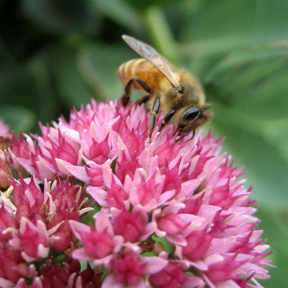
In other news, the sweetest of my 3 hives of bees (led by queen Ruth Wilson) limped through the winter, only to meet their demise this spring. It was a little unexpected and cleaning out her hive boxes left me feeling especially glum. As a bee keeper I harbor a big responsibility for my girls. I wondered over and over what else I could have done to help them. And if loosing thousands of little bees wasn’t enough to break my heart, having to put our dog of 8 years to sleep last week was. We are slowly trying to adapt to the ghost dog that has taken her place. It’s hard.

I guess it should be no surprise then that some of this sadness has followed me into the kitchen. I’ve turned out a few duds lately. Most of them have at least been edible, but one went to the dogs – literally. I knew this experiment had gone bad when my friend Charly, a man who is not afraid to bring road kill into the kitchen, found it hard to choke down. This was an ultimate low for me. Charly loves food. He’ll eat nearly anything. I know, because over the years I have seen him happily indulge in plenty of my mistakes. I’ll be ready to chuck something into the compost and Charly will intervene for another helping. Not this time though. This time Charly suggested we feed the remains to his team of Siberian sled dogs. Ouch.
I had made stuffed eggs for our May picnic outing. The picnic was lovely. The eggs were not. Having just pruned off the tops of my basil seedlings, I enetered into the kitchen with a handful of aromatic goodness and tried to get inspired. I decided to make use of our egg surplus and stuff a dozen of them, hard boiled, with a savory basil-anchovy-egg filling. Evidentially I was a little heavy handed with the anchovies. The dog team is still barking about my culinary prowess.
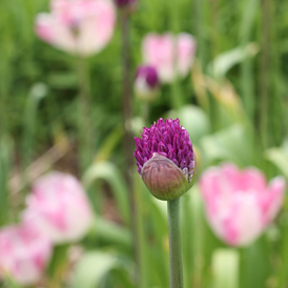
We took our May picnic at one of my all-time favorite destinations – the Winter Greenhouse in Winter, Wisconsin. If you look at a map of Wisconsin, you will find the town of Winter in the upper west quadrant of the state, smack dab in the middle of nowhere. Which I realize is not unusual for a lot of little Wisconsin towns. What sets Winter apart is that it is home to what is truly one of the most amazing plant nurseries I have ever visited. (My husband Mark can attest that this is no small number). So each spring we make the 2 hour pilgrimage south to walk their grounds and greenhouses and get inspired by color, texture, and patterns. Then I typically load as much of this inspiration as can fit into the back of our little car and head back north to spread the beauty.
This year we found a quiet bench in one of their shade gardens to enjoy our picnic lunch. Despite the egg fiasco, the rest of our fare was quite tasty. Hands down, the star of the picnic was a kale salad. With the exception of preparing the salad, I have to give all remaining credit to my friend Landis. Not only did she provide me with the recipe, she grew the kale to boot. And I’m so glad. Because she has hereby turned me on big-time to spring kale. Until this salad I didn’t even know there was such a thing as spring kale. In my book, kale is a sturdy fall green that tastes even better after a kiss of winter frost. Spring kale, I have discovered, is something altogether different. It is tender and sweet and frilly. And it is perfect as the base for a raw salad. It was so fantastic that we were scrapping the bottom of the container before I even had time to snap a photo.
Kale Salad with Chilies & Pecorino
(Adapted from  Melissa Clark’s In the Kitchen with a Good Appetite)

1 bunch of tender spring kale
1/4 cup coarse homemade bread crumbs (from a slice or two of good bead)
1 small clove garlic
1/4 teaspoon salt
1/4 cup grated pecorino or Parmesan
3 tablespoons olive oil
Juice of one lemon (about 1/4 cup)
1/8 – 1/4 teaspoon recd chili pepper flakes
Salt and black pepper to taste

Trim about 2 inches off the kale stems (you can save these for a soup or stock). Slice the kale into 3/4 inch ribbons. You should have about 4 to 5 cups. Place kale in a large bowl.

Using a mortar and pestle or a heavy knife, pound or mince the garlic clove with the salt into a paste. Transfer the garlic paste to a jar with a lid and add the grated cheese, olive oil, lemon juice, chili flakes, a pinch of salt and fresh ground pepper. Give it all a good shake and gently pour it over the kale. It will take a bit of stirring to get all of the leaves well coated. Let stand for about 5 minutes and serve with an additional sprinkling of cheese, bread crumbs, and/or olive oil.
antsy pants

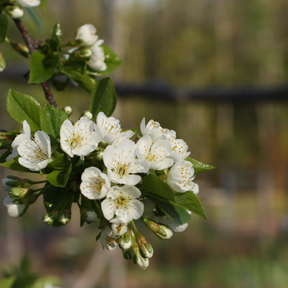
This is the time of year that I tend to get a little squirrelly. The peas and radishes are up, but they’re weeks out from being ready to eat. Same with the first crop of carrots and beets. The tart cherries are in full bloom, but a pie is at least a month off. Basically, the garden at this point is brimming with hope, but not much action. There’s rhubarb, that’s promising. But even as much as I love those tart crisp stalks, theres really only so many places you can take them. Which leaves me pacing the freshly strawed garden paths and twiddling my thumbs.

Inevitably my gaze falls on the showiest thing in the garden – an innocent row of perky garlic. And I wonder out loud, “Should I?” Meaning, dare I indulge myself and recklessly dip into the fall harvest prematurely? When garlic is harvested at this stage it is referred to as green garlic. It looks something like a cross between a scallion and a leek – just a straight slender stalk, without its traditional bulb attached to the end. Herein lies the dilemma. What could potentially become 8-15 individual plump cloves of garlic instead gets scarfed down as one. And that’s it. Party’s over. It feels like such a disgrace, such a rip-off to the garlic plant.

I casually avert my eyes for a moment. Oh the agony! Green garlic is really good. It is everything I crave this time of year. It’s earthy and mild and fresh and garlicky. It puts the lingering heads of our fall stored garlic to shame. But it just feels so wrong. Still, I can’t help myself. I never can. A stalk here to mix in with the pasta. A stalk there for an asparagus frittata. And several stalks to make spinach and green garlic soup. This really feels like going overboard, but it is so worth it. So much so that I now make it a point to plant a small bed each fall of what I know is going to be harvested as green garlic. Somehow it eases my guilt. At least a little. It’s not like I went and got anyone’s hopes up or anything. Those garlics knew their fate right from the get-go.

Any remaining doubt is generally absolved when I take a deep inhale over the resulting steamy bowl of bright green garlicky goodness. I am normally a slow eater. Painfully slow by some people’s standards. But not with this soup. This soup puts my hand into high gear, involuntarily spooning it into my mouth faster than I can keep up. It dribbles down my chin. I don’t care. I lick the bowl clean and then go back for another scoop to do it all over again. It’s so earthy and green, I literally feel my body soaking it up after a winter’s worth of starchy root crops.

On my second bowlful, I generally come up for air long enough to dunk a piece of buttered baguette into my bowl and have a sip of wine. My friend Mary, who knows way more about wine than I do, recently turned me onto an amazing petite sirah, old vine zin and old vine mourverde blend (Phantom) from Boggle. It’s as earthy and as deep as this soup – in a wine sort of way. They are a match made in heaven. And with that, I know I’ll make it. I can put my antsy pants back on the shelf for another year. Summer is nearly here. I can taste it. I just hope the peas and carrots get on with things in a timely manner. For the garlic’s sake.

This recipe is an adaptation from Zuni Café in San Francisco, via one of my favorite food blogs, Orangette. I usually sacrifice at least a baker’s dozen (sometimes more) of garlic plants for the soup. If you don’t have your own garlic plot to contemplate pilfering, (or even if you do, but happen to have more restraint than I do) fear not. This is the time of year you are likely to find green garlic shoots at farmer’s markets and other places that sell local produce. You’ll want to use just the tender white and pale green parts of the plant. Save the tougher green tops for use in a vegetable stock if you’re so inclined. You could also try the soup with regular garlic, but I would use just a few cloves, minced and simmered just a titch longer. It’d still be a lovely way to celebrate that long awaited spring spinach.

Spinach and Green Garlic Soup

2 Tbsp. unsalted butter
1 Tbsp. olive oil
1/2 – 3/4 lb. trimmed green garlic (13 -15 1/4″ thick stalks), thinly sliced
Salt & pepper
4 cups vegetable stock (homemade or boxed)
10 oz. fresh, spring spinach leaves, chopped if the leaves are large
1 Tbsp. yogurt, keifir, or crème fraîche
Fresh lemon

Heat the  butter and olive oil in a soup pot over medium heat. Add the green garlic and a pinch of salt, and cook, stirring frequently, until it is soft and translucent, about 10 minutes. You should notice the pungency of the garlic mellowing as it cooks. Add the stock, bring it to a boil, then turn down the heat to keep a gentle simmer going for about 15 minutes. Add the spinach, and turn off the heat. Stir the spinach in and let it sit covered for just 5 minutes. Puree the soup using an immersion blender (or regular blender).

Stir in 1 Tbsp. of yogurt, keifir, or crème fraîche, another pinch of salt and a grind or two of pepper. Taste, and adjust seasoning as necessary.

Serve warm or hot, with a squeeze of fresh lemon and a few drips of yogurt, keifir, crème fraîche.

Serves 4 (Unless your body is totally thirsty for greenness. Then you could possibly, maybe, eat almost an entire pot all by your very self. I know. I’ve done it.)


lucky thirteen

It’s official. I’m in love. Madly in love. I married a man who makes a homemade pizza almost every Sunday night. He’s missed a few here and there, but by and large, come late Sunday afternoon, he’ll stop what he is doing, don an apron, open a bottle of wine, and take over the kitchen. We celebrated out thirteenth wedding anniversary yesterday. I figure this man has made me well over 600 pizzas. How could I not be in love?
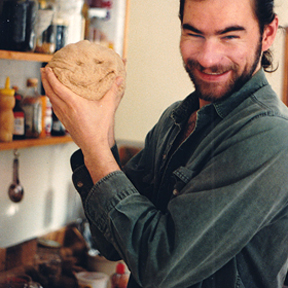
I credit myself with having the brilliance to teach him how to make a simple whole wheat crust years before we got married. We were living in a small cabin in northern Maine with no water and no electricity. Our kitchen was small and sparse, but there was just enough room to roll out a pizza crust. But truthfully, my involvement in the matter pretty much stops there. Since then Mark has taken it upon himself to perfect his craft. Years ago he acquired a small jar of sourdough starter from a coworker. I’ve made it clear that I love my husband, right? Good, because that said, I didn’t have high hopes for the starter. Mark is an idea guy. Follow through has never been his strength. But let me tell you, he tends to his starter like nothing I’ve ever seen. If he happens to be away or miss a Sunday, he’ll make a mid-week pizza instead. And if that fails to happen, he’ll be sure to take a little starter out and freshen it up so it’s alive and ready for the next week. Excuse me while I eat my words. And along with them, hundreds of fabulous sourdough crusted pizzas.
At some point in this pizza love affair, Mark dubbed Sundays as Bistro Night. He generally spiffs up, puts on a classy shirt, and proceeds to dote on me like I’m a tourist at some crazy Italian café. With lively accordion music playing from the Bose, he’ll offer me a small bowl of black olives to snack on or a slice of fresh mozzarella to tease my palate. Occasionally he puts me to work grating cheese or chopping garlic, but generally he shoos me out of the kitchen. He prides himself on making the thinnest crust possible – because he knows that’s how I like it. And if I really sweet talk him, I can sometimes convince him to make my very favorite crust – a creation where he stuffs the edges with a mixture of cream cheese, chev, and chopped jalepeños. It’s a bit more fussy, so I have to get my request for this in early. In the summer months he takes his café outdoors and throws the pizza on the grill instead. And the toppings! Lets just say that Mark is not shy to experiment. If it’s in the refrigerator, it’s fair game. Chopped broccoli has become a favorite. Other winners include pesto, grilled chicken, artichoke hearts, jalepenño stuffed olives, chorizo, spicy greens, and even fresh strawberries.
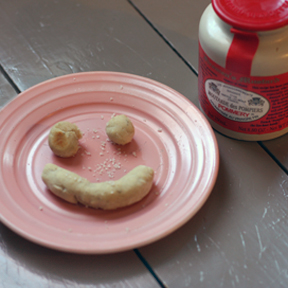
But the real reason I’m so in love is not about the pizzas. Here’s why I am truly smitten. Still desperately trying to catch up at work, I spent the better part of this past Sunday at my desk. Around 5:00, I went down to the kitchen for a glass of wine and retreated back to my computer. About a half hour later, with familiar smells wafting up through the grate in my office floor, Mark came upstairs with a treat for me. Nothing fancy – just the scraps of left over crust, baked and sprinkled coarse salt. But his presentation was everything. Shaped into a smiley face, served on my favorite little pink plate with a jar of hot mustard to dip into. “Happy Anniversary,” he said, and went back down to the kitchen. Be still my beating heart. It’s been thirteen years and I feel as lucky as ever.
I can’t even remember the last time we had a pizza made with a plain-jane crust. In addition to the sourdough factor, Mark usually kneads a combination of fresh garlic and herbs into his crust. But if he ever left the pizza making in my hands (not likely since he hasn’t yet in 13 years), I would probably turn to the standard whole wheat crust that I grew up with. Thin and chewy, it’s one of the very first things I ever learned to make. But in the meantime, I’ll keeping making reservations at the best little bistro I know. Lucky me.
Whole Wheat Pizza Crust

few drops of honey
3/4 - 1 tablespoon dry yeast
3/4 cups warm water (95 - 105 degrees)
1 1/2 - 3 cups whole wheat flour (or a mix of flours – substitute some semolina for an especially thin crust)
pinch of sea salt
oil
cornmeal

Pour warm water into a medium sized mixing bowl and add a few drops of honey. Dissolve the yeast and let it sit for a minute or two. Add salt and gradually stir in flour – enough to make a nice, not too sticky, elastic dough. Knead it 3 - 5 minutes, either right in the bowl or on a floured surface. Let the dough raise, covered, 15 - 20 minutes before rolling out the crust. Preheat oven to 375 degrees.
On a floured surface, roll the dough into a circle or rectangle – don’t be affraid to pull and tug the dough a bit to help it conform to your desired shape. Lightly oil a baking sheet, dust it with cornmeal and transfer the crust to the pan. If you like a crispy crust, it helps to pre-bake it about 10 minutes. You can also pre-bake the crust for 10 minutes and freeze it for a quick meal later on.
Prepare your pizza a desired and finish baking at 375 degrees until top is bubbly and melted.

forge on (project picnic.2)

I realize that we’re already into the double digits of May, but I’m still stuck on April. For what it’s worth, it has come to my attention that I am currently behind on just about every aspect of my life. So indulge me. All the way back to April. Almost always, I consider April to be the home plate slide into spring. But not this year. This year, April was cruel. This year, April boasted more “snow events” than March. Less overall accumulation, but still, it’s  painful. After 7 months of cold, snowy weather I start to get anxious for some heat and humidity. Yes, I said humidity. I’m sort of sick in the head that way. But that’s a whole different post. What I really want to talk about is our April picnic. Which is tricky, because it didn’t happen. The weather on our proposed date was a gusty, snowy, grey 27º F. I couldn’t take it anymore. I put the picnic basket back in the shed and we went out to dinner.

I reasoned that we could just double up in May. I have high hopes for May. And things are looking up weather-wise, despite the fact that there were flurries on May Day and the day after. Snow flakes aside, last week we had our make-up picnic. Not at all what I was intending, the affair ended up being a late night dinner with the picnic blanket spread out on the floor in front of the wood stove. Did I mention that I am struggling to keep up lately? Mealtime appears to be no exception. Still, it did feel sort of picnicky.
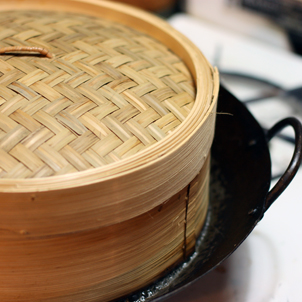
I decided to go Asian. I made my first ever batch of steamed buns, filling them with spicy kimchi. I had never attemped theses delights before, but I was inspired because I thought they would make the perfect hand food for a picnic. All in all it went pretty well, though there were a few stages in the process where I was longing for a Chinese grandmother by my side to gently guide me. But I managed to muddle through with the help of a YouTube video. While the buns steamed I made a simple soy sauce dressing to dip them in.
And then I started in on one of my all-time favorite salads. It also happens to be my potluck offering of choice when I’m pinched for time. Super quick, not fussy, and it doesn’t violate my “no nondescript rice dish” policy for potlucks. Plus, I know it’s a winner because someone generally asks for the recipe. I typically make this salad with shelled edamame, but this time I mixed it up. I’ve been in Minneapolis more than I’d care to be lately. As an incentive I have been rewarding myself with an ongoing tour of my favorite grocery stores. At Bill’s Imported Foods, my latest and most treasured destination, I found a bushel basket of plump fava beans that I couldn’t resist. So I used them in the salad in place of edamame. The result was as tasty as usual – nutty and fresh. And it got me especially revved up for the two rows of favas that are just starting to poke up in our garden.
I kept the rest of the picnic fare pretty simple, rounding the meal out with some zingy wasabi chick peas – one of my latest addictions, and fortune cookies for dessert. My cookie presented me with some particularly timely wisdom. “You could accomplish many things that you give up in despair.” Wow. If this isn’t exactly what I needed to hear. Especially lately when it sometimes feels easier to give up rather than catch up. I taped my fortune to the top edge of my keyboard and glance at it throughout my workday. At the most basic level it keeps me plowing through and forging on. But it also reminds me to live large, dream big, and check my skepticism at the door.
Corn and Bean Asian Salad
Adapted from Isa Chandra Moskowitz and Terry Hope Romero’s Veganomicon

Dressing:
2 tablespoons toasted sesame oil
1 tablespoon rice vinegar
2 teaspoons soy sauce

Salad:
2 cups shelled edamame or fava beans
1 1/2 cup sweet corn (fresh or frozen)
2 tablespoons toasted sesame seeds
salt to taste

Whisk together the dressing ingredients. Bring a large pot of water to boil and cook the edamame for about 5 minutes, If using favas, boil the beans for one minute, drain, let them cool and slip the beans from the tough outer skins. Return the shelled beans to a pot of boiling water and simmer for 2 – 4 minutes until they are bright green and tender. In the last two minutes of cooking (either type of bean) add the corn. Drain the corn and beans in a colander and run under cool water. Transfer to a bowl and toss with the dressing, Add the sesame seeds and salt to taste. Chill salad prior to serving.

Serves 4-6 as a side dish

probationary potatoes

I’ve been put on couch potato status until further notice. If it were anything other than my eye at stake, I might rise up and revolt. This is not a good time of year to be relegated to the couch. The peas and radishes and sweet onions are begging to be planted. My bees are flying, madly in search of a pollen source. I am dying to take a peek in their hives and rearrange their furniture a bit. But, I promised my eye surgeon I wouldn’t. I’m not saying she didn’t trust me, but she did feel the need to go ahead and deputize my husband Mark to keep me in check. I’m sunk.
I’m doing my best to embrace the situation. I’ve pulled out my flannel sleeping bag and my Hello Kitty pillow to make a giant nest in the sofa. The only problem is that I typically have to jockey with Hoops for a spot. The coffee table is stocked with magazines and cookbooks – all within easy reach. I don’t read long before my eyes prefer to drift shut and rest, but still, it’s a comfort to know that they’re there.
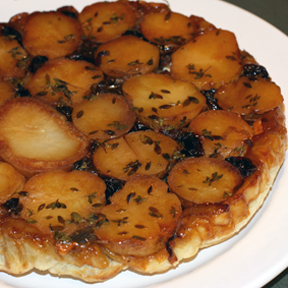
Sunday afternoon though I managed to keep my eyes open for a bit. And I must have been feeling a little vindictive because I realized I was perusing indexes specifically for potato recipes. If I was going to be deemed a couch potato, then I was going to cook potatoes. Try and stop me. But I didn’t want to make just any old potato dish. I wanted fancy potatoes. I was just about to give up and settle for good old-fashioned Bangers and Mash when I came across an entry under potoatos in Yotam Ottolenghi’s book Plenty for Surprise Tatin. This sounded encouraging.
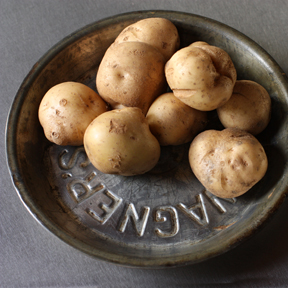
Ottolenghi calls for baby new potatoes, cherry tomatoes, fresh oregano, and hard goat cheese. I didn’t have any of these, but I did happen to know that the last of our summer potato crop was still underground, waiting to be dug. Years ago we discovered (quite by accident) that this is a nice solution to our limited root crop storage problem. We dig half of the hills in the fall, and leave the rest in the ground for a spring treat. The snow cover keeps them toasty enough and just like with carrots, parsnips and rutabagas, the kiss of cold sweetens them up perfectly. As for the rest of the ingredients, I always keep a big jar of dried Sun Gold cherry tomatoes in the pantry that I figured would work just fine. No oregano, but the thyme plant – always an over achiever – is already spreading and sporting new spring leaves. And I had some firm goat milk feta in the fridage that I could slice up. I was in business.
I sent the deputy outside with the pitch fork and the colander and wrangled myself out of the couch. Delving further into the recipe I discovered that Ottolenghi actually has you semi-dry the tomatoes in the oven anyway. Perfect – a little hot water over the Sun Golds and I would be good to go. I think you could use just about any type of tomato – dried, oven roasted, oil packed form a jar, even fresh as long as they have a low moisture content.
The best thing about this tart is the wonderful flavor combinations. Sweet, tangy, rich, and earthy all blended together in a delicate shell. Mark said he felt like Remy from Ratatouille with little firework explosions going off in his mouth as he ate. But the second best part of the recipe is that even though it sounds fancy, and looks fancy, it really is quite simple to make. Don’t let the length of the recipe fool you. Fry some onions, boil some spuds, prep the tomatoes and you’re basically set. The only mildly fussy step is making the caramel glaze for the bottom of the tart and even that takes all of 2 minutes (and 2 minutes well worth it!) An effortless puff pastry sheet for the crown and in the oven it goes. I made sort of a hodgepodge salad to accompany the tart, but I think some simply dressed bitter greens like arugula or endive would be dynamite.
Who knew couch potato probation could be so decadent? Maybe I’ll even miss it, but I doubt it. I am glad to report that the eye surgery itself went very well. Now I’m in a post-surgery waiting game, trying to be patient and let Ma Nature work her magic. Friday is my first visit back for a check. It’s wishful thinking I know, but I’m hoping to get an early release for good behavior.
Couch Potato Tart
(adapted from Yotam Ottolenghi’s Plenty)

1 1/4 pounds small potatoes (skins on)
1 large onion, cut into small wedges
1 heaping cup cherry tomatoes (see note)
2 tablespoons butter or olive oil
1-2 tablespoons fresh thyme leaves
5 ounces firm feta or other hard goat cheese
4 tablespoons sugar, plus 1 additional tablespoon butter
1 puff pastry sheet
salt and pepper
parchment paper

Note: for the tomatoes, you can substitute a large handful of dried cherry tomatoes, reconstituted in hot water, or a small jar of oil-packed, sun dried tomatoes. If using fresh cherry or roma tomatoes, halve (or quarter if they are large) and put them skin side down on a baking sheet. Drizzle a bit of olive oil and salt and pepper over the tops. Bake in a 250º F oven for about 45 minutes until the are dry and gooey.

Bring a pot of salted water to a boil and cook the potatoes until they are just tender. Drain and cool. Trim the very tops and bottoms of the potatoes off and slice them into 3/4″ thick discs.

Slowly saute the onion in the butter or olive oil until the onions are slightly brown and caramelized. Sprinkle with salt and pepper and remove from heat.

Brush the bottom of a 8 1/2 or 9 inch tart or pie pan with a bit of olive oil and cut a parchment paper circle to fit the bottom.

In a small heavy saucepan, cook the sugar and 1 tablespoon of butter over high heat, stirring constantly until it turns into a rich carmel color sauce. This will only take about 2 minutes. Be careful not to take it so far that it hardens and cracks. Pour the caramel into the bottom of the tart pan and carefully spread it around the base of the pan.

Scatter the individual thyme leaves over the caramel. Next arrange the potato discs, cut side down to fill the tart pan (you can leave just a teeny bit of space along the outside rim of the pan to accommodate the puff pastry lid). Press the tomatoes and onions in and around the potato gaps. Sprinkle the whole thing generously with salt and pepper. Then lay the sliced goat cheese on top of the potatoes. Roll the puff pastry sheet so that it is about an inch larger than your pan. Drape it over the top and gently tuck the sides of the crust down into the pan, around the potatos.

Bake the tart in a hot 400º F oven for 25 minutes, then turn down the heat to 350º F for an additional 15 minutes of baking. The pastry should be golden brown and cooked through. Remove it from the oven and put the tart pan on a clean plate or baking sheet. Let it settle for 2 minutes. Then take another plate, put it face down on the tart, pick up the whole shebang and flip it over (the first plate keeps you from having to handle the hot tart pan directly). Lift off the pan and you are ready to serve. Hot or warm.

Serves 4 to 6.

a good eye

People occasionally tell me I have a good eye for things. And maybe I do. But I also have a bad eye. This eye, my bad eye, is plum tuckered out. And I don’t blame it. It’s been through a lot. A virus has plagued my left eye for over a decade. Sometimes it quiets down and behaves itself, but even still, years of medication use have led to other complications. It’s doing everything it can to keep up with my good eye, but frankly, it is losing the battle. And so this week, my bad eye is at the University of Minnesota for a little surgical intervention.
There was so much I wanted to write about before giving my attention over to my bad eye. I was hoping to give the inaugural spring garlic report. I will let slip that the brave new shoots were nearly buried in 3 inches of snow Saturday night. But that’s the beautiful thing about garlic. It doesn’t mind so much. And even I had to admit that the green and white contrast was striking. And I was going to tell you all about the ingenious “Bloody Mary Burgers” that my husband Mark grilled up – in spite of the wintery April weather. Think Worcestershire sauce, horseradish, Tabasco, a dash of cajun salt, and a squeeze of sun dried tomato paste mixed in with the ground chuck. Mix yourself  an umbrella drink and you could almost pretend it is summer.
But some weeks, no matter how hard I will it to be otherwise, time gets the better of me. And this past week was one of those weeks. I guess I’m not holding my breath for the week ahead either. I’m afraid all I have to offer up is a couple of photos I took at the Franconia Sculpture Park en route to Minneapolis. I was instantly attracted to – or rather into – a big, rusty barrel of a sculpture. Once inside, the bright sunshine and gusty winds were blocked, but small rays of light seeped through the seams at odd angles. It felt safe and comforting inside the tube. It felt like a good place to be.
I had one of those moments of brilliance that typically last only a split second and are not easy to express. But in a nutshell, I felt so glad, so lucky, to be standing in a dark tube and seeing light. And that was it. It sounds hokey, I know. But it was the little push I needed to get myself on down the road towards my destination.
Good and bad aside, the one constant that both of my eyes provide me is perspective. And I’ll never turn down a serving of that.

flash and flounce

This might just be my favorite time of year. Of course, if you were to ask me again at the start of any of the other seasons, I would probably take it all back and insist that the season in question is actually my favorite. Nevertheless, there is no arguing how hopeful spring feels. And right now, that’s all I need. The generosity of summer and lucidity of fall can wait their turns.

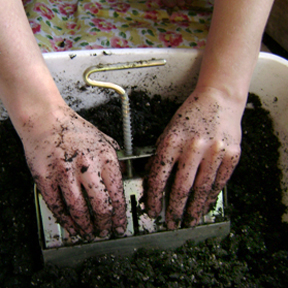
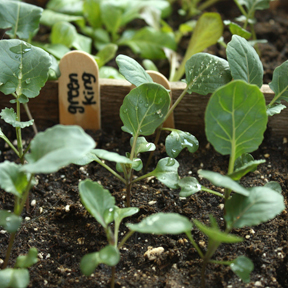
There is no end to the list of springtime events that jazz me up. But my undeniable, hands-down favorite is starting seeds. This is the time of year when trays of little seedlings slowly begin to  take over our living room. The seedlings grow in numbers and size, all of them looking so perfectly green and perky, reaching for the light. Looking at them and watching them grow gives me complete hope. Plus there is the added perk of getting my hands all mucky every time I mix up a new batch of soil and start another tray. It’s a win-win activity. I sit with my morning coffee, brushing my fingers over their sturdy tops, giving them a taste of stronger spring winds to come.

All of this is a result of the continual supply of seed catalogs that the mailbox has offered up throughout the winter. I respectfully thumb through each one, but there are two in particular that I spend and inordinate amount of time with. Neither of which is fancy – no photos, the guts of both printed in black on newsprint. But here’s what I love about them. They are works of art, chock-full of amusing drawings and original art. Both offer subtle political commentary and historical accounts on seeds and gardening. I could read them like novels. And I do. So who are these two mystery seed companies you ask? Fedco Seeds, based in Waterville, Maine and R.H. Shumway’s in Randolph, WI. (I should note that both of their websites pale in comparison to their catalogs. If you’re a fan of garden seeds, do yourself a favor and get on their mailing lists for an actual catalog.)
I sort of went wild ordering flower seeds this year. When it comes to flowers, I generally favor subtle, understated blooms. Dainty plants like Lady’s Mantle, Lavender, Green Gold Bluplurium and Sacred Basil. I’m not sure why, but I more or less wrote off big showy blossoms years ago. So this year as I was going through the catalogs, I was surprised to find myself involuntarily marking some untypical selections. I went all out and ordered things like Dinner Plate Dahlias, State Fair Zinnias, Caribbean Cocktail Nasturtiums, and giant Crackerjack Marigolds. Clearly a shift was happening. I was craving flash and flounce.

As far as vegetables go, I have my tried and true favorites that I grow each year. But I always bring in a few new recruits too. I’m looking forward to the debut of Cubanelle, a thick, waxy, semi-sweet frying pepper. And to a small Russian pickling cucumber (Early Cluster) introduced to the U.S. in the 1850’s. I learned from the Shumway’s catalog that Danish Ballhead is the best old-fasioned kraut cabbage. Several cabbage seedlings are already up and thriving, eager to fuel my kraut and kimchi addictions. And there is one other noteworthy arrival to our garden this year. An under appreciated crop I have never even attempted before. Celery. I chose the open-pollinated variety Ventura from Fedco, because its description reassuringly opens with “Takes the difficulty out of growing celery.” Seems like a good enough place to start.

I don’t know, celery has always seemed like one of those veggies that is just easier to buy. That being said though, I often find there is a lot that can go wrong with store bought celery. It can be just right, but it can also be too stringy, too limp, too bitter, or too sharp. I’ve been on a celery  and celeriac kick lately, so I decided to try my hand at both in the garden. If I had to credit just one celery recipe that inspired me to do so, it would be this knock-out celery salad. I’ve made it all winter and I fall a little more in love with it each time.

Now I acknowledge that celery salad sounds a little dull, but I assure you, it’s not. This is celery at its best. This is celery being flouncy and flamboyant. And it chooses the absolute perfect accessory – shaved Parrmesan. Oh, and the dressing! Don’t even get me started on the dressing! Here’s how good the dressing is. I usually end up with extra. But instead of cutting back on the quantities, I always make the full amount. Because any leftover dressing does wonderful things to whatever it is drizzled over – other veggies, a fried egg, rice, crusty bread – you get the idea.

Flamboyant Celery Salad
Adapted from Ina Garten (I’m not sure which book. I scribbled down notes for this recipe in the library, but failed to note which book I was paging through)

5 cups thinly sliced celery (use the heart and the most tender stalks)
1 tablespoon lemon juice
1/2 teaspoon salt

the dressing:
1/2 cup olive oil
2 teaspoons lemon zest
1/4 cup lemon juice
3 tablespoons minced shallots
1 teaspoon celery seed
1/2 teaspoon Penzy’s English Prime Rib Rub (or celery salt)
1/2 teaspoon anchovy paste

the accessories:
Shaved Parmesan (2 -4 ounces)
1/4 cup pine nuts, toasted

Put celery in large bowl, pour 1 tablespoon lemon juice and 1/2 teaspoon of salt over the celery. Whisk together the dressing ingredients and add enough dressing to moisten the celery. Let the salad chill for at least an hour to allow the celery to crisp up and absorb the flavors. Transfer to a platter and top with shaved Parmesan (a vegetable peeler works great for this) and toasted pine nuts. Salt and pepper to taste.

Serves 4-6

eat my pie (project picnic.1)

One of the best perks of being self-employed is having fairly nice control over my schedule. It doesn’t always work out perfectly, but in general, I can tweak it when necessary. And so last week, when my husband Mark was on holiday from teaching biology to his darling sophomores, I planned accordingly. We decided to go all out and head to the exotic locale of Duluth, MN. Crazy, I know.

I booked a couple of nights at the historic Fitger’s Brewery Hotel overlooking Lake Superior. Unlike most times we travel, we chose our accommodations precisely for the room. We were banking on spending some time there. I requested a lakeside room that had high ceilings, picture windows that actually open, brick walls, lake view – certainly not the Caribbean, but there was hot running water. It would work for me. I packed a novel, a few cooking magazines, the backgammon board, and our well-stocked travel bar that my friend Linda made for us years ago (think vintage sewing suitcase decoupaged with bar-humor and other happy artwork).
We did our fair share of roaming the city, but, as planned, we also spent a considerable amount of time in the historic hotel. Lazy morning coffee morphed into gin and tonics. We sat in front of the picture window, pretending it was spring as we watched for big lakers passing though beyond the frozen bay. Mark kept the daily paper open to the shipping news, announcing which vessel was due when, binoculars at the ready. This year’s shipping season began on March 17 with the departure of the James R. Baker from Superior. On our last morning over a game of backgammon, Mark announced that the largest boat on the Great Lakes (the Paul R. Tregurtha at 1,013 feet, 6 inches long) was due into port around noon. It’s been a long winter. It doesn’t take too much to excite us.
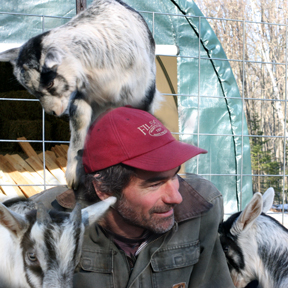
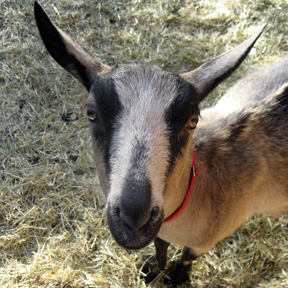
The rest of the week we spent at home. I did do some work, but I also managed to squeeze in some playtime. We had our annual “baby goat happy hour” with our friend Michael up the shore at Sassy Nanny Farmstead Cheese. This is the time of year when Michael is overflowing with baby goats (this year’s season total was 34). And every year I forget how funny they are. They exude mischief and playfulness. It’s contagious. I didn’t even mind when Delilah, a nursing mom, came over and took a large pull on my gin. She’d earned it.
Now don’t laugh, but we also did marathon viewing of Project Runway – a fashion based reality show. We don’t watch many movies or television (we are television free with a computer monitor for DVDs) and I can honestly say that I have never seen a single episode of any reality show. But when my friend Julie handed over a season’s worth of Project Runway a few weeks ago, I was intrigued. She has never steered me wrong in any avenue of life, and she stayed true to form on this one. I was instantly hooked. Entertaining, but also inspirational. I wish I had that amount of passion and confidence for something. Plus, I need a little glam in my life. I’ve already professed my love of Tim Gunn to Julie and asked her for the next season.
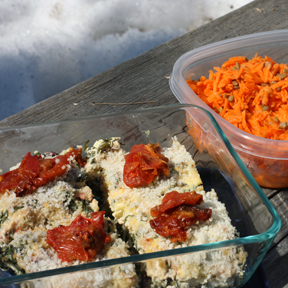
And, speaking of projects, we had the first picnic of my 12 month project picnic goal! March was fickle this year. Our yard still has a good foot of snow. Overall it has been grey, cloudy, snowy and wet. I’ve sort of been twiddling my thumbs, waiting for a chance to break out the picnic basket. So when the sun finally decided to pop out last week I thought we’d better give it a go. I sent Mark out to the fire pit to shovel out and get things going. Meanwhile I pulled together a simple lunch. Carrot seed salad, homemade salsa and chips, dill pickles, and a chard pie (leftover from dinner the night before). I packed up the basket for its inaugural voyage, and before I headed out to the fire, I stuck a lovely little lemon cake in the oven. Picnicking at home has its advantages.
Now I know chard pie does not sound all that exciting. But trust me. It is so tasty. And so easy. I won’t even mention how good all those dark leafy greens are for you. That’s like an extra secret bonus. Really, you should eat this pie.
I make this all summer when the garden is overflowing with chard. Sometimes I also mix in spinach, kale, beet greens, etc. It travels well and it is great served hot, cold, or at room temperature. This recipe is an inspiration via Laurel’s Kitchen.

Popeye Pie

2 cups ricotta cheese (I’ve also used cottage cheese)
2 eggs beaten
1/4 cup fresh lemon juice
1/2 teaspoon salt
2 large bunches of chard (about 2 pounds) lightly cooked, stems and all
1/2 cup panko breadcrumbs
paprika (I prefer a hot smoked paprika)
fresh, dried, or roasted tomato slices for topping
To cook the chard, chop it coarsely, keeping the stems separate. Discard any really tough stem ends and finely dice the remaining stems. Start the stem pieces cooking about 5 minutes before you add the leaves. Cook the leaves until they are just tender and wilted, but still bright green. Drain the chard into a colander and squeeze out as much liquid as you can.
Beat together cottage cheese, eggs, lemon juice and salt. Fold in the chard and press into 8×8 baking dish. Sprinkle with panko and paprika. Bake in a 350º F oven until set, about 1/2 hour. Let stand to cool for several minutes before serving. Serves 4-6

dark dairy days

I have to say that I am not much of a milk drinker. Prior to the Dark Days Challenge, I can’t even tell you the last time I bought a quart of milk. We do use a bit of fresh goat milk (when it’s in season) courtesy of my favorite ladies at Sassy Nanny Farmstead Cheese. And every now and then we’ll open a box of rice milk to see us through. But the DD Challenge proposed a dilemma. Boxed rice milk is far from local, and the girls at Sassy Nanny weren’t producing during the darkest days of winter. I realized that although I may not feel the urge to sit down to a tall glass of cold milk, I might just start craving cheese, butter, and yogurt on local nights.
And so early last December, towards the beginning of the 50-mile radius foods challenge, I made a memorable trip to Tetzner’s – our local cow dairy. I bought 3 quarts of cream and 4 quarts of milk. It proceeded to sit in the fridge for a good number of days until I finally decided I had better do something with it. I went straight for the gold and made a tub of ice cream and pound of butter. Emboldened with my success, I moved on to yogurt and kefir. And I have been having a dairy heyday ever since. Jars of fresh cream and milk have become regulars in our refrigerator this winter.
I have a huge new crush on homemade kefir. I’ve had it store-bought from a carton many times, but it has always struck me as too sharp and too tangy. I never go out of my way for it. So I was pleased to find that my homemade version is bright and smooth. It’s so easy to drink and eat just plain with nothing added. I started my initial batch with a kefir starter that I ordered online. I have been using either that or a few tablespoons of existing kefir as starter, both with good results. But now I’m so infatuated that I want to want to take things one step further and search out some actual kefir grains. I learned in my research that the Turkish word “keif” translates to “feel good.” And now I know why.
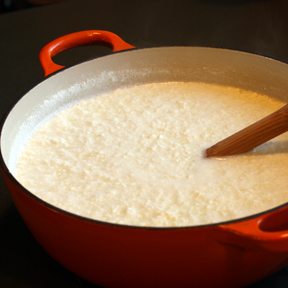
Homemade ricotta was next on my list. I couldn’t believe how easy it was. It took all of 15 minutes (plus 20 more minutes for it to drain through cheesecloth). The taste is so superior to store bought that I don’t think I’ll ever go back. Like most of these homemade dairy products, the price breakdown is comparable to store bought but with several other benefits –  it’s local, it’s fresh, the taste is outstanding, AND I don’t have to litter my cupboard (or landfill) with wayward little plastic yogurt, cheese, and ice cream containers.
Throughout all of my dark days dairy escapades this winter, I kept coming back to the butter. My inaugural batch was good, but that was all. Just good. I had a taste off with a few store-bought butters I had on hand and it didn’t compare. Mine tasted overly milky, and (for lack of a better descriptive) boring. Especially next to the newest love of my life – a butter from  Rochdale Farms, a small creamery in southern Wisconsin.
I discovered this marvelous, hand-rolled butter about a year ago at a food co-op in Minneapolis. I proceeded to became so addicted to it that I wouldn’t make a trip to the Twin Cities without a small cooler in tow so I could bring home several pounds for the freezer. I even went so far as to plan a trip to the cities (4 1/2 hours one way) based purely on the fact that we were out of butter – though I didn’t openly admit this scheme at the time. But it’s okay. I’m in recovery now. Mostly because I worked all winter to create a clone of Rochdale butter.
First I had to discern what is is about this butter that sets it apart from other butters (even really good butters). It has a tang and saltiness that is unmatched in other contenders (especially mine). I went online to do a little research. Sure enough, I discovered that Rochadle Farms adds a bit of cultured whey to each small batch of butter they make. That would explain the unique tanginess. I didn’t have cultured whey – and wasn’t sure how to go about making it, but I did have cultured kefir. Ding! I was onto something. A bit more research and I had formulated a recipe for cultured butter. After one or two attempts and tweaks, I successfully absolved my dependence on Rochdale Farms butter. Because now I can make it all on my own at a moments notice. Not, of course, without the help of the cows at Tetzner’s Dairy who have earned my enduring gratitude.
I haven’t tried this using yogurt as a culture, but I think it would work just as well. Just be sure it is plain yogurt that still has live cultures in it.

Cultured Butter

3 cups heavy cream (not ultra-pasturized)
2 tablespoons kefir
1/8 – 1/2 teaspoon fine sea slat (optional)

Pour cream and kefir into a large glass measuring cup or bowl. Gently stir to combine. Cover with a clean towel and allow to rest in a warm spot (about 75 degrees F) overnight.

The cream mixture should be somewhat thick by this point. Pour cream into the bowl of a food processor or an electric mixer and process on high speed. It will thicken almost immediately, and then turn to whipped cream. As it continues to thicken, begin to watch for a slight graininess. Shortly after this it will become noticeably yellow, grainy, and butter will clump together in the bowl. Stop processing as soon as you see butter clumping together – it’s important not to re-integrate the butter back into the buttermilk. This whole amazing process takes a mere 2 – 4 minutes.

Pour the buttermilk off (you can use this in muffins, pancakes, fruit smoothies, etc.). Refrigerate the butter for about an hour to firm it up for final removal of buttermilk.

Press and knead the chilled butter using your hands or the back of a wooden spoon. The goal is to work out every last drop of buttermilk. This is also a great time to knead in salt if you want salted butter. I like a salty butter when I’m not cooking with it, so I use a half teaspoon. Rinse the butter several times in ice-cold water as you knead; once the water runs clear, the butter is done.
Roll into a sheet of wax or parchment paper and store in the refrigerator or freezer.

Makes about 3/4 pound butter.

slow tilt

Yesterday was the vernal equinox. And, like every year, I had such high hopes. I went to bed Saturday night, filled with promise. But I knew right away Sunday morning that something had gone awry. I laid in bed, listening to the tell-tale sound of a shovel at work. Once I established I was truly awake and no longer dreaming I went to the window for a final confirmation. Sure enough, I looked down to see my husband Mark clearing off the deck, the dog futilely trying to catch each shovelful of snow. I tapped on the window and gave a meek wave.

This wasn’t at all what I had in mind for the first day of spring. But I could rally. It’s still the day when the earth miraculously straightens itself out and faces the sun dead on. And this excites me. We’re on the home stretch. The sun is finally starting its slow tilt towards the sun. An effort that can only lead to good things. I poured myself a hot cup of coffee, put on my boots, and went out to assess the damage.

The world was white, cold, wet, and drippy. Searching for optimism, I wedged open the purple garden gate and stepped inside my sanctuary. My favorite flowered chair (hand painted by my sister-in-law) was still sufficiently snowed into the corner of the garden. I took a seat anyways and gave things the once over. I spied the tip of a green onion that had more or less survived under a blanket of snow. It wasn’t completely full of life, but it was mildly reassuring to see something in that shade of green. The hand-cut dogwood sticks I use to mark the garlic rows were just poking above the surface of the snow. That was encouraging. I got up and went to investigate the parsnip bed. It was still covered with heavy blankets of snow and straw, but I knew the value of the jewels stowed beneath. I set off looking for other glimmers of hope, but the false crust of snow quickly gave way to my weight and my boots filled with what felt like especially cold snow.

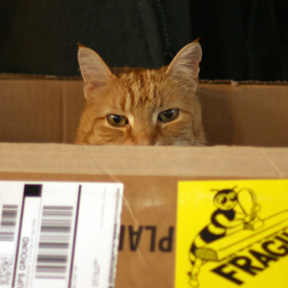
Enough of that. I retreated back inside. I found Hoops (our very wise cat) next to the wood stove, nestled deep into a box of bee supplies I had recently ordered. The two of us seemed to be on the same page. This day was clearly meant meant for cozying up. And baking. I wavered between some sort of elaborate tropical meringue with pineapple or mango or coconut – and something more fiery. I opted for the later. Partially because my pantry was lacking in the tropical fruit department, and also because I had just discovered we were out of eggs until this week’s local egg drop from Spirit Creek Farm.

I found a spicy hot ginger cookie recipe that fit my mood perfectly. And bonus – no eggs required. The recipe is from Breakfast · Lunch · Tea, a cookbook from the Rose Bakery in Paris. It’s a lovely book, filled with inspiring photography and scrumptious recipes, all perfect for – you guessed it – breakfast, lunch and tea. I have overly ambitious plans of making a complete Rose Bakery brunch later this spring. We’ll see if I can pull it off.
These cookies (or biscuits, to be more Brittish about it) are zingy and not overly sweet – my favorite combination. They are packed with the warmth of ginger and the cayenne adds a perfect heat that sort of hits you after you’ve swallowed. I’m glad to have a cookie jar full of these zesty treats, because from the looks of the forecast, the sun is just not tilting fast enough.
A few recipe notes: I substituted a mild honey for the corn syrup the recipe originally calls for. The recipe also calls for 1 1/2 tablespoons of baking soda, which seems excessive to me. I scaled it back to 1 1/2 teaspoons. I didn’t have self-risng flour, so I substituted cake flour (which has a lower gluten content similar to self-rising) and added 1 teaspoon baking powder and 1/4 teaspoon salt per cup of flour. So about 3 teaspoons powder and 3/4 teaspoon salt. Lastly, I topped the cookies with a generous pinch of large grained raw sugar – which gives them an occasional extra sweet crunch.

Hot Gingernut Biscuits (adapted from Rose Carrarini’s Breakfast · Lunch · Tea)

200 grams (scant 1 cup) unsalted butter, cubed, room temperature
440 grams (scant 3 cups) self-rising flour
150 grams (3/4 cup) sugar
3 tablespoons ground ginger
healthy pinch of cayenne pepper
1 1/2 teaspoons baking soda
240 grams (8 ounces) mild honey
40 grams (2 ounces) molasses
Raw sugar for sprinkling on top

Blend the dry ingredients in a mixer for a few minutes to combine well. Add the cubed butter and mix until it is incorporated into the flour. Gently warm the honey and molasses in a small sauce pan and add it to the flour mixture. Mix to form a stiff dough. Break off pieces of dough and roll them into 1 inch circles. Place on a parchment lined baking sheet and bake at 325º F for about 10 minutes. When the cookies are fresh, hot from the oven, give each cooke a pinch of raw sugar.

Makes about 3 dozen cookies


instapig

No Instagram images were found.