Archive for the 'pig slop' Category


hot cakes

I live in northern Wisconsin. Which means I live with no less than six months of winter. Truly, if I had it my way, I think I’d hole up and hibernate with the neighborhood black bears. But, no. It’s become pretty clear that no one else up here on the south shore of Lake Superior seems to share my sentiments. In fact, sometimes the winter months feel as jam packed as summer. Go ahead. Burst my bubble. I’ll do my best to embrace it.

The craziness kicks off with Santa and Mrs. Claus arriving on the Madeline Island Ferry. And then there’s the Apostle Islands Sled Dog Race – a 2 day dog filled affair, followed by the Blue Moon Ball with the 20-piece Big Woods Band. We barely have time to catch our breath before the Book Across the Bay – a 10k ski race across Superior’s iced over Chequmegon Bay. Frozen beach parties, trips across the ice road to the Island, maple sugaring, snowshoeing. It never ends.

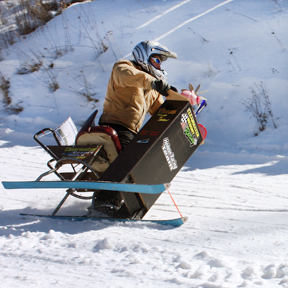
But the winter event that I have come to appreciate most is the Drummond Bar Stool Races. This is exactly what it sounds like. Every year, dozens and dozens of grown adults gather on the third Saturday in February to race bar stools mounted onto skis down a man-made hill. Welcome to northern Wisconsin. Laugh if you will, but people take this event seriously. Listen carefully in the crowd and you’ll overhear people discussing snow conditions, wax choices, barstool aerodynamics, test runs, and pushing strategies.
Barstool teams consist of two people – a rider and a pusher. A stoplight at the top of the hill gives pushers the cue to propel their rider down the hill. It doesn’t take long to discern that the best strategy is to have a pusher with some weight and brawn paired with a slim built rider. Shortly into our first time spectating, my husband leaned over and said “If we ever compete – you’re riding.” It’s been five years, and we still haven’t had the gumption to register.
Notice how the pusher (in white) in the right hand lane has gone into an all-out belly slide? Notice how the rider in the right lane has caught some air?
This particular third Saturday in February was a gorgeous, sunny 28º F day. I might have even gotten my recommended daily allowance of vitamin D. For whatever reason though, the course and conditions boasted an unprecedented amount of crashes and ties. It was a highly entertaining race.
The barstool races have become a tradition for Mark and I, and we generally make a day of it – kicking things off with a hearty breakfast at the Delta Diner. The Delta Diner is an authentic roadside diner located in the heart of Delta, Wisconsin. Which means it is located in the heart of nowhere. But it is worth the trip. Really. Check your GPS. If you are within an hour (maybe even two) of Delta, make the detour.
Owner and cook Todd Bucher provides a gastronomical experience that is unforgettable. Breakfasts are out of this world – including a thoroughly refreshing Mexican Eggs Benny. Add a side of crunchy hash browns and you won’t need to eat for the rest of the day.  Also offered up are traditional blue plate specials, old-fashioned  malts, fish-frys and specialty burgers. Todd and his wife Nina make a point of using as many local ingredients as they can find. Could it get any better?
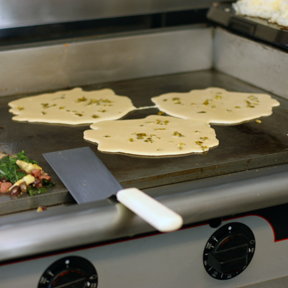
One of the house specialties is thin, Norwegian style pancakes. And while it’s not officially on the menu, if you ask for “hot cakes” Todd will throw a handful of chopped jalapeños onto your cakes. Brilliant! I have dreams about these pancakes. The tang of hot meeting sweet is so amazingly perfect. Why have I not thought of this before?
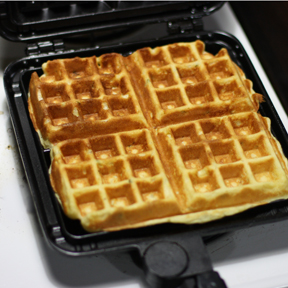
And so it is that I have Todd to thank for my latest kitchen inspiration – Jalapeño Cornmeal Waffles. I took my favorite waffle recipe (clipped from somewhere long ago), substituted cornmeal for part of the flour and added a healthy handful of chopped jalepeños to the batter. And whoo-eee did they ever surpass my expectations! The cornmeal offers a perfect nutty crunch to the jalapeños. Winter does have it’s perks. And zingy waffles on a Wednesday night is one of them.
Jalepaño Cornmeal Waffles

1/2 cup flour
1/2 cup cornmeal
3 tablespoons cornstarch (for extra crunch)
1/2 teaspoon salt
1/2 teaspoon baking powder
1/4 teaspoon baking soda
3/4 cup buttermilk
1/4 cup milk
6 tablespoons canola oil
1 egg, separated
1 scant tablespoon sugar
1/2 teaspoon vanilla extract
handful of chopped jalapeños (fresh or pickled)

Mix dry ingredients in a medium bowl. Separate egg, and reserve the white in a small bowl. Mix the yolk with the rest of the wet ingredients in a 2-cup measuring cup or bowl. Beat the egg white with a hand mixer until soft peaks form. Sprinkle in sugar and continue to beat until glossy. Beat vanilla into the egg white.
Pour the wet ingredients into the dry and mix until just incorporated. Gently fold in egg white and jalapeños, but do not over mix!
Add batter to hot waffle iron and cook until golden brown and crisp.
Makes 2 full sized Belgian waffles.

fill me

I’ve been in a breakfast rut lately. Maybe it’s the mid-winter doldrums. I mull around the kitchen, open the fridge, peer into the pantry, but nothing really jumps out at me. Except for this past week. This past week there was left over Valentine cupcakes. And yes. I have a weakness for cake. Especially when it involves breakfast. But, like all good things, the cupcakes came to an end. Which is probably just as well. Bikini season is just around the corner.

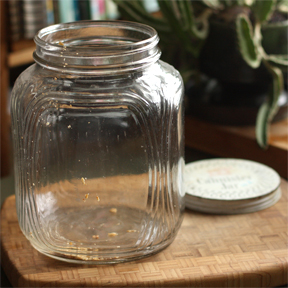
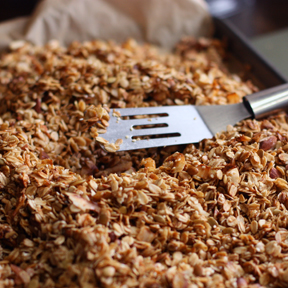
This morning though, I realized the source of my problem. The granola jar has been empty for weeks. I’m not exactly sure why. We almost always have granola on hand. But there it was, empty as could be, staring me in the face. “Fill me” it whispered. And so I did.
I have several granola recipes, but I tend to latch on to certain ones for long spells, making them over and over again – ignoring all other contenders. Among past pet favorites is a version loaded with toasty cinnamon. My friend Cari introduced me to it on a backpacking trip and I was immediately smitten. Three tablespoons of cinnamon takes the chill out of the morning air like nobody’s business. Before that it was a fruit laden number that I adapted from Bon Appétit. But my new, all-time, number one favorite, is a subtle, seedy affair with coconut and honey. It has stayed in rotation longer than any other.
The recipe originated from sort of an odd source – the Anti-Inflammation Diet and Recipe Book, by an N.D. named Jessica Black. The subtitle beckons “Protect Yourself and Your Family from Heart Disease, Arthritis, Diabetes, Allergies – and More.” I picked it up a few years ago for the “and More” claim. Hopefully to help slow the progression of irreversible inflammatory glaucoma in my eye.
I have to admit that I didn’t have terribly high expectations for the recipes, but I have been pleasantly surprised with everything I have tried. If nothing else, the book is an interesting read. Black does an easy job of explaining the three different families of prostaglandins (fatty acids) found in foods. Two types (PGE1 and PGE3) are “good” and the other (PGE2) is a “not so good” pro-inflammatory type. Naturally, the book focuses on recipes with foods that are high in camps 1 and 3.
But good or bad prostaglandins aside, this granola is a winner. I love that it uses honey for the sweet and coconut oil for the fat. Two of my favorite ingredients. (If the thought of raw coconut oil scares you, I urge you to do a little research. It’s an amazing fat that has gotten an unfair bad rap for way too long.) The light, subtle coconut flavor matches perfectly with the oats. This is an understated granola but its flavor and texture are spot on. And who knows, maybe it really will help protect us and and our families from all the nasties out there. Who can argue with that?
Granola with a Conscious
(Adapted from Anti-Inflammation Diet and Recipe Book)

6 cups raw oats
1 1/4 cups unsweetened flaked coconut
1 cup chopped almonds
1 cup raw pumpkin seeds
1/2 cup sesame seeds
1/2 cup honey
1/2 cup coconut oil

Mix all of the dry ingredients together in a large bowl. Gently heat the honey and coconut oil to a liquid. Pour over dry ingredients and mix well. Press into a parchment lined baking sheet and bake in a 325º F oven to your desired level of toastedness, 20-40 minutes. Store in an airtight container. (Milk, incidentally is high in PGE2, which means if reducing inflammatory foods is your goal, you should serve this with a milk substitute such a rice milk or almond milk.)

easing up

I have a new addiction. And I’m pleased to say that it is not NyQuil – though for a while there, that magical green liquid was in a tight race for second. But no, my new crush is something much more wholesome and liver-friendly. Puzzling. This isn’t a particularly new pastime for me – my husband Mark and I always tackle a jigsaw over the Christmas holiday, and sometimes we’ll break one out during a rainy stretch. But lately, I seem to be on a mad puzzling streak.

True to form, Mark and I kicked off the season this year with a rather tricky Monster’s Inc. puzzle – an affair that involved way too much blue monster fur. Still, it was Mike and Sully and therefore hard to resist. Nevertheless, I handily packed it up to pass on, ready to reclaim our table. But then I surprised myself by pulling out another puzzle. And then another. And there is still one more waiting on the shelf.

At first I thought it was just a way to pass the time while I was sick and under the weather. I’m still not running at 100 percent, but I’ve definitely turned the corner. Only my puzzling habit hasn’t let up accordingly. And now I’m starting to realize it for what it truly is – pure escapism. Ten minutes over coffee, extended lunch breaks here and there, and squandering away valuable kitchen time “just until I find that one piece.” Mark has even doled out a few mandatory puzzling sentences if I’m worked up or fretting about something. And let me tell you, it works!

My Grandpa Milt was a puzzler. He often had a special card table set up to accommodate his 1000 piece forays. I’d eagerly sit down to help, but it was never too long before I lost interest. I remember wondering what the point was. But now, after all these years, I finally get it. The point is to sit down at your table and disappear into a world of colors and shapes and textures. I love running my hand over the completed sections and feeling the smooth cardboard beneath my fingertips. The beauty of puzzling is that it lets my brain shut off while still maintaing a nice level of concentration. That’s a good mix – and hard to come by sometimes.

So I guess my addiction isn’t all bad, late dinners aside. But I should share how I kicked my NyQuil habit. After about my fourth or fifth dose I was eager to find a better and safer solution to the cough that had settled uncomfortably deep into my lungs. And so I tried a home remedy that has been scrawled in the back of one of my cookbooks for years. I was skeptical at first, so I made up just a quarter batch (I could care less about tossing out a little whiskey, but wasting a cup of honey – now that’s just foolish!) I took a few swigs of my concoction during an explosive coughing spell, and sure enough, I could almost instantly feel my lungs and chest easing up. Another shot before bed sent me straight to sleep. The next day I made a full recipe.

I used raw honey, which simply means it has not been processed or heated. But I think any honey would have the same soothing effect. I also forewent the schnapps, but in retrospect, I think it would have been a lovely taste enhancer. I stored my syrup in a glass canning jar with a lid at room temperature. I’m sure it has a pretty decent storage life, but after a certain point, I think it would probably be better just to start fresh.

Paw Paw’s Cough Syrup

1 cup whiskey
1/4 cup peppermint schnapps
1 cup liquid honey
2 lemons

Squeeze lemons into honey and add whiskey and peppermint schnapps. Stir until throughly mixed, shake if needed. Sip until your coughing troubles leave (or you just don’t care anymore).

denial

Never try to outsmart your immune system. It just doesn’t work. I know this, but it still didn’t stop me from trying to fool myself. I’m not really sick, I decided. I’ll just take a few extra vitamin C, drink more fluids and get on with things. Well the joke’s on me. Because this week, I really am sick. There’s no foolin’ no one.

I spent the bulk of the week on the couch with one large orange cat and one small orange dog piled on top of me, box of Puffs within easy reach. My beverage of choice was what I refer to as a “juice cocktail” – a concoction from my youth of half orange, half 7-up, over ice, ideally served with a bendy straw. Between cocktails I alternated with plenty of water and green tea spiked with lemon and honey.
I washed my hands approximately 83 times a day. I know because I had to either heat up or get hot water from the wood stove every time. It gets old after about the forty-second time. To appease myself, I spent a considerable amount of time online (who knew there are so many choices?!) picking out a faucet for our soon-to-be new house. A faucet from which hot and cold water will freely flow. The thought of it gives me chills. Or maybe that’s just my fever coming back.
My appetite waned considerably throughout the week. That’s got to be one of the biggest drags about being sick. I love getting hungry and dreaming about all the amazing things I could eat to satiate myself. This week though, when it came to food, all I thought about was a sleeve of saltines and a rather zingy soup. I didn’t eat much, but I made a point to have a small bowl of soup (sans garnishes) each day just to keep something in the tank if nothing else.
I had made a big pot of this soup back in my “I’m not really sick” phase and it’s a good thing. Because it fed us all week long. And it only got better and better. As my friend Andy says, sometimes a soup just needs to linger in the pot a while in order to really get to know itself. And after a few days, this soup had no questions about who it was. It was a smooth talker – thick and silky. It was pungent and spicy, but mellow at the same time. And it was pure comfort.
I used a semi-hot curry powder homemade by my friends Ulf and Pat. And I intentionally used a lot of it – in hopes of giving my “little cold” a good kick in the pants. I also didn’t shy away from the cayenne. Feel free to use a combination of hot and sweet curry and/or to reduce the amount (though using anything less than 2 teaspoons seems downright silly – it is curry soup after all).

Sweet Potato Curry Soup
(adapted from the North Carolina Cookbook)

2 tablespoons butter
4-5 large shallots (enough to make about 1 cup chopped)
3 stalks celery, finely chopped
2 tablespoons finely grated ginger
1 tablespoon curry powder
1/2 scant teaspoon cinnamon
1/4 teaspoon cayenne
1/8 teaspoon nutmeg
2-3 pound sweet potatoes, peeled and cut into 1/2 inch chunks
6 cups stock (I used half turkey and half garlic, or chicken would work great too)
1/2 teaspoon thyme
1 bay leaf
1/2 cup milk
sour cream or creme fraiche
roasted peanuts, chopped

Melt the butter in a large soup pot and add the shallots and celery. Cook until tender and lightly browned. Stir in the ginger, and all of the spices except the thyme and bay leaf. Cook, stirring for about a minute. Add the sweet potatoes, stock, thyme and bay leaf. Add salt and pepper to taste. Increase heat and bring soup to a boil. Lower heat to medium-low and let simmer for about 25 minutes, or until the sweet potatoes are tender. Fish out the bay leaf and either transfer soup to a blender in batches, or use an immersion blender to purée the soup. Stir in the milk and serve, garnished with a dollop of sour cream and crushed peanuts.

anticipation

Well, I suppose it’s inevitable. When you’re burning the candle at both ends, it’s only a matter of time before you’re immune system gets fed up and throws in the towel. Which is why both my brother (guilty of the same offense) and I spent Christmas day battling over the kleenex box and discussing the merits of liquid DayQuil versus gel caps. (I prefer the ease of the caps, he finds the liquid soothing on his throat. But we both agree the liquid kicks in faster). Tim had it worse than I did, so I really can’t complain. But still, being even a little sick on Christmas is a drag.

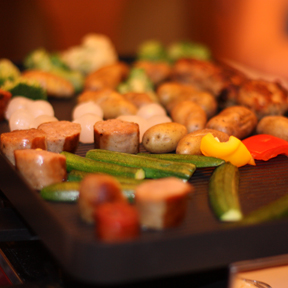
Blame my cold or the NyQuil induced fog, but I’m sad to say my camera barely made it out of my bag this Christmas. Which is too bad, because my family has recently started a tradition of a fonduing for Christmas dinner. Talk about a photo op. As it is though, you’re just going to have to image the piles of bright peppers, the perfectly browned-bubbly Raclette cheese, the itty-bitty zucchinis, the mounds of sausages and shrimp, and the lemon slices daintily bobbing in a silver pot of steaming broth.
This year my mom went all out. She did away with the old avocado green Goodwill fondue pots and upgraded to a cast enamel flame pot for oil, an electric pot for broth, and a fancy Raclette grill for cheese. As we cooked and ate, my mom explained the traditional Swiss method of heating an entire wheel of Raclette cheese and scraping slices directly onto plates of steamed potatoes, cornichons and onions.
The modern-day Raclette setup allows individual slices of cheese to broil underneath a grill of hot vegetables. Each diner gets a handsome little scraper to slide their bubbly cheese onto their plate. Keeping in the true spirit of things, we served our cheese atop fingerling potatoes, onions, and pickles. And let me tell you, the Swiss have this flavor combination figured out! The cornichons in particular we’re such an amazing taste perk. It certainly woke up my cold-ridden taste buds.
As for the standard fondue, we always do a pot of sizzling oil for meats, but we’ve also experimented with a few different broths. We’ve come to favor a ginger infused chicken broth. It’s a lovely cooking medium for broccoli, pea pods, mushrooms, and cauliflower. And my personal favorite is plump sea scallops simmered in the ginger broth with a side of Asian dipping sauce. It’s a combination I look forward to all year. That’s what I love about traditions – the anticipation.
Best wishes to you and yours for a bright new year ahead!
Ginger Fondue Broth

4 cups chicken stock
2/3 cup white wine OR 1/4 cup rice vinegar
4 lemon slices
2 large cloves garlic, minced
3 – 4 tablespoons minced ginger
2 teaspoons sugar

Combine stock, wine, lemon slices, garlic ginger and sugar in a saucepan. Just before serving heat to simmer and transfer to a warm fondue pot. Adjust heat to maintain a simmer while fonduing. Wonderful with veggies and seafood.

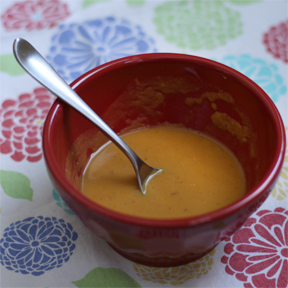
Spicy Asian Dipping Sauce 

1 1/4 cups granulated sugar
1/2 cup rice wine vinegar
1 lemon zested and juiced
1 tablespoon soy sauce
1 teaspoon salt
2 teaspoons fish sauce
2 teaspoons minced ginger
2 teaspoons minced garlic
1 teaspoon crushed red pepper flakes
1-2 tablespoons grated carrots
1-2 tablespoon chopped cilantro

In small saucepan over medium heat, combine the sugar, vinegar, lemon zest and juice, soy sauce, salt, fish sauce, ginger and garlic.  Bring to a boil, stirring often.  Reduce heat to a simmer and cook for 5 minutes.  Pour  into serving dish and add the crushed red pepper flakes.  Allow sauce to cool completely before adding the carrots and cilantro. (For a smoother texture, strain the sauce as you pour it into the bowl.) Makes about 1 cup.

living proof

I’m busy. Have I mentioned that? I have temporarily bitten off way more than I can chew. I’m not complaining – there is a light at the end of the tunnel. It’s dim, but if I squint, it’s there.

My primary source of entertainment for the last 2 months has come in random 28 minute snippets when I sneak off to stream old Office episodes. I’m pretty sure I’ve subconsciously started channeling Dwight Shrute. I’m not sure if that’s good or bad, but I am considering painting my office walls black to intimidate my subordinates. Wait. I don’t have any subordinates. Damn. Maybe I’ll just put a bouncy castle outside my office instead.
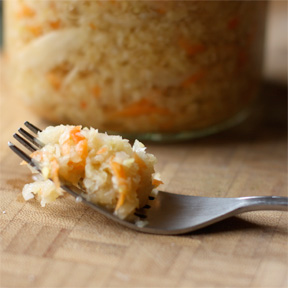
The other night I put on a pot of brown rice, sauteed up some garlic and kale, fried a few eggs, piled it all together and topped the whole shebang with a mound of spicy kimchi. I was so pleased with my accomplishment, I thought I was worthy of a James Beard award. That’s how much cooking I’ve been doing lately. The kimchi was homemade though. It was my last kitchen fun before all hell broke loose. I often find myself going to the fridge mid-day for a forkful, dreamily recalling the days when the produce was plentiful and I had time to spend in the kitchen.
Last night I bundled up at dusk to harvest the last of the kale, chard, and brussel sprouts. I’ve kept them covered with tattered bed sheets, but the jig is finally up. The temperature has been hovering at 26º F for the last few days and the skies have been grey and laden with snow flurries. I’m pretty sure I audibly sighed as I put the last of our bounty into the crisper drawer. It’s not that I don’t appreciate winter and everything it brings, it’s just so hard to say good-bye to the garden. On the most basic level it’s like my own little convenience mart, ready to serve me 24/7. But on a deeper level, it’s my place to go. My reprieve.
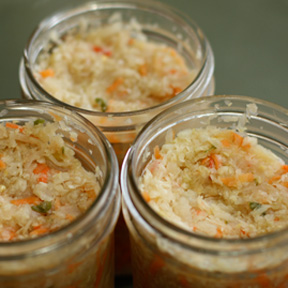
But still, I guess I have the crock pickles, the kraut, and the kimchi. Actual living proof of the garden. Sure, there’s squash, potatoes, and beets too. But somehow those seem less dramatic. Less zingy. My foray into fermentation as a preservation method is relatively new one, but I couldn’t be more excited about it. First off, it’s easy. Way less fuss than canning. But more importantly, the food tastes different. It tastes, well, alive. Because it is. And it fills that deep craving I have for fresh, home-grown food.
This wasn’t always the case, mind you. For the first half of my life, I wouldn’t go near sauerkraut. And kimch? Never heard of it. When I eventually did, I didn’t really want to know anymore. At some point I got radical and granted them “condiment status” on my plate. And luckily, somewhere in there, I was treated to tasting real, home-made versions. They were like completely different foods. And now – now I generously pile them onto sandwiches, stir them into rice, mash ’em into potatoes, top off meat dishes, and stand at the the open fridge door for a quick forkful.
My go to fermentation book is Sandor Ellix Katz’s Wild Fermentation. I’m sure I’ve mentioned him before, but one of the things I appreciate is his simplistic, small scale approach. I can crank out a quart of kraut or kimchi in less than a half hour of real work, and even then, my Cuisnart does most of it. There is some checking and periodic tasting involved, but if you forget about it for a few days, it doesn’t matter. For the most part, it just sits inconspicuously in the corner while the fermentation does all of the real work.

Spicy Cabbage Kimchi 
(adapted from Wild Fermentation)

1 pound napa cabbage
a handful of red radishes
2 carrots
sea salt and water

Grate or chop the vegetables. I think kimchi is traditionally pretty coarse, but I prefer a finer version (a Cuisnart does a marvelous job at this – especially if you happen to be busy!) Mix up a brine by combining about 4 cups cold water and 4 tablespoons salt water. Make sure all the salt dissolves and then taste it. It should taste like the sea. Put your vegetables in a large ceramic bowl and pour the brine over them. Use a plate with a weight on it to completely submerse the vegetable. Cover with a clean dish towel and let soak over night.

Next you need a spice mix. Definitely tailor this to your taste buds. This is my latest favorite combination.

1 small onion plus a handful of shallots, chopped
1 head of garlic, chopped
4 hot chilies (in my last batch I used Chillipeños, but use whatever you have, fresh, or dried, seeded or not)
2-3 tablespoons fresh gingeroot, grated
a splash of fish sauce

You want everything in the spice mix all pretty finally minced and mixed together into a paste. Again, the Cuisnart is invaluable for this.

Drain the brine from the veggies, reserving it. Taste the vegetables for saltiness. You want them to be decidedly salty, but not unpleasantly so. If the seem way too salty, give them a rinse under cold water. If they don’t seem quite salty enough, sprinkle a few teaspoons of sea alt on them.

Mix the spice paste in to the veggies and work it in so everything is combined. pack the mixture tightly into a quart jar, pressing down on it as you go so that the brine begins to rise above the vegetables. And that’s it, your work is basically done. Now the jar sits in a quiet, out of the way place in your kitchen for 1 to 3 weeks. The only ting you have to be sure of is that the vegetables stay below the brine. You can do this by just plunging them down back into the brine every day with your hands, or use a weight – like a smaller jar or ziplock filled with some of the reserved brine. Cover the jar with a clean towel and check it every few days to see how it is progressing. Over the corse of a week or more (depending on temperature) the kimchi will start to ripen and get that nice little zing. When it gets to tasting how you like it, cap the jar with a lid and store it in the fridge.

grandma rose

I actually don’t have a Grandma Rose. I had a Grandma Marjorie and a Grandma Myrtle. But my Italian friend, Gina – she had a Grandma Rose. And a few weeks ago, I got to know Grandma Rose a bit. Lucky me.

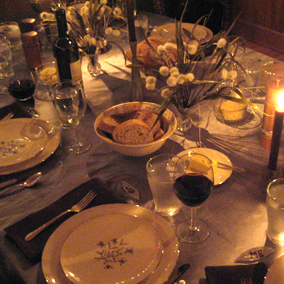
I’m married to a Libra. Coincidentally, four of my closest friends (there is a fifth, but work moved her out of the area) are also married to Libras (and okay, there’s one Scorpion in there, but he’s on the Libra cusp). Nevertheless, Gina has graciously taken it upon herself to throw these boys a birthday dinner each October. I’ve often felt that I completely lucked out in meeting and marrying my husband, and this is just one more perk to add to the list. Gina puts such thought into each year’s theme and meal. And she insists that we do it properly and get all gussied up. It’s a dinner that I look forward to all year long.
Inspired by a trip to Montana this past summer, Gina decided to cook a genuine Italian feast for this year’s dinner. Now I know know Montana and Italy aren’t commonly associated with each other – especially when food is on the line. But Montana is where scores of Gina’s Italian cousins and aunts live. And so they gathered to cook, to teach, to learn, and to remember Grandma Rose. Prior to the trip, Gina compiled a small booklet of Grandma Rose’s recipes – complete with typos and all. I have a copy. I love it. I live for family stories like this.
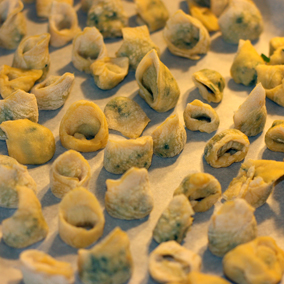
The highlight of this year’s birthday dinner (for me at least) was that we got to help prepare it. I’ll be first in line for a cooking lesson any day – especially one with friends. Gina invited us to gather at her kitchen table on Friday morning to help make TORTLACH – also referred to as  “large hats.” Large hats stuffed with an amazing cheese, spinach, breadcrumb filling. Not to be confused with TORTELLINI, Gina explained  – which are “small hats” stuffed with a pork based filling. While making the filling, Gina told us about her Grandma Rose, her food, her cooking, her roots. I smiled when I realized that the more Gina talked, the less she was actually following the recipe that was laid out in front of her. By the end it was a handful more of this, another pinch of that. Gina was doing it all by feel. Grandma would be proud.
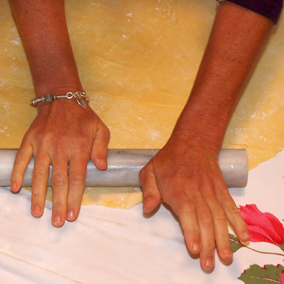
Filling ready, it was time to roll out the pasta dough. A flowered tablecloth covered our work surface. I mentioned I had never thought to roll out dough on a cotton cloth. “That’s how we know it’s thin enough,” Gina instructed. “We roll until we can start to see the flower print through the dough.” And yes, we were rolling the dough out on Rose’s tablecloth. I felt honored. Gina coached us, intervening when necessary, and we took turns rolling until sure enough, we could see faint flowers. Gina cut the dough into thin strips and then into squares. Then she gave us a quick “large hat” making lesson. Fill, pinch, wrap around thumb, pinch again.
“Now this is what it’s all about,” Gina proclaimed, as we all pulled our chairs up around the table. “This is where we dish out the gossip.” We joked around as we fumbled our way through making our inaugural large hats. But as filling and making the hats came more easily, so did the conversation. Before we knew it, two hours of talk had slipped away and the counters were overcrowded with trays of tortlach.
We hugged our good-byes and departed filled with anticipation for the next night’s meal. I drove home, feeling accomplished and feeling blessed. Back at my desk life felt richer. And how could it not? I had gained a third Grandma, at least for the day.

garlic pusher

I fear that I’ve been a little remiss at promoting the planting of garlic. Now is the time people! At least in the northern hemisphere. Really anytime between the end of September and right up until the ground freezes works. I shoot for mid-October here in northern Wisonsin. It doesn’t always work out that way, but fortunately, garlic is pretty forgiving.

Ideally you want the garlic to get a jump on growing and set down a few roots before winter sets in. Then come spring it will shoot up as the ground thaws and be on its way. It’s really a glorious sight. If push comes to shove, you can even plant in the early spring, but who really  wants to stick their fingers into icy cold soil? Do it now, while there is a least a glimmer of summer left.

Ready for a garlic planting crash course? It’s really easy, I promise.

1. Find yourself a few nice heads of garlic – ideally of a variety you enjoy.

2. Break apart the head into individual cloves. Pick out the largest ones and set aside any itty-bitty ones for eating. Leave the paper skin intact, but don’t worry if a bit of it pulls away.

3. Find yourself a patch of loosely fluffed soil – even a big pot on the deck or in the garage will work. Maybe work in a bit of compost if you have it.

4. Poke each clove in (root end down, pointy tip up) about twice as deep as the clove itself, 6 to 8 inches apart. Give a little pat of encouragement to each clove as you fill in the soil around it.

5. Put a good layer of mulch (by good, I mean 6-8 inches worth) over the top of your patch. I use straw, but leaves would work too. If you are leaving a pot on the deck, mulch it extra well around the sides too so it doesn’t freeze too hard. I think a shed or garage would be the best bet. Then just drag the pot outside in the spring.
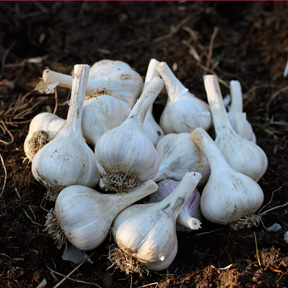
And that’s it. I assure you that the hardest part is waiting. But it’s so worth it. Because if you’ve planted a little extra (did I mention you should plant a little extra?) you can harvest a few shoots of pencil-thick green garlic in the early spring and make amazing things with them. Even if you didn’t plant a little extra, you’ll still be okay. Come June you’ll get a fine crop of twirly scapes that you can make more amazing things with.

If all goes well, by late summer you’ll have significantly more garlic than the few heads you started out with. Which means fewer vampires and more amazing things in the kitchen. Like this garlic sauce, which is deliciously good on almost everything. Just keep an eye out for the devil.

The Devil’s Sauce
(adapted from Chester Aaron’s Garlic is Life)

2 red or mild banana peppers, coarsely chopped
1/2 – 1 habañero chile, seeded and chopped
1 cup chopped onion
3 tablespoons red wine vinegar
2 tablespoons olive oil
2 tablespoons sugar
1/2 teaspoon cumin
1/2 teaspoon adobo seasoning (or use all cumin)
4 tablespoons red pepper flakes (aleppo if you have it)
10 large garlic cloves (about 3-4 ounces), roasted*
1 1/2 teaspoons sea salt
black pepper to taste

*I use Romanian Red garlic, which has fairly large cloves. If you’re using a variety with smaller cloves, you may need way more than 10 cloves to make 3-4 ounces. To roast it, put the individual cloves in a little foil packet, drizzle with some olive oil, salt and pepper and roast at 350ºF for 45 minutes to an hour until cloves are tender and can squeeze easily out of their papers.

For the sauce, blend the peppers, chile, and onions in a food processor to make a purée. Transfer to a saucepan and add the vinegar, oil, sugar, cumin, and adobo, and pepper flakes. Simmer gently for about 5 minutes before adding in the roasted garlic. Mash everything up a bit and simmer for about 5 more minutes. Add salt and pepper and adjust to taste. Makes about 2 cups. Store in fridge, freeze, or pressure can (15 minutes at 10 psi).


knock your socks off

Remember Earl? Our foster dog? Well, it’s official. We’ve gone and adopted him for keeps. Earl (like a lot of rescue dogs) arrived at our door with some baggage. Something tells me he still has a bit of unpacking to do, but I’m not too worried. So far we’ve been able to deal with everything he’s pulled out of his case.

Near as I can tell, his main ambition is to sit as close to people as is physically possible while making curious little squeaking noises. It’s become clear to us that Earl is not familiar with the concept of the personal space bubble. Still, it’s sort of endearing. He’s a funny little guy. Baggage and all.

But here’s the thing about Earl. Actually it’s two things.
1. You simply can not, in any way, be in a hurry around Earl. It doesn’t work. He’s nervous enough as it is, but he gets especially anxious when people start rushing around. So it’s best to just move slowly and yawn a lot. And you should sort of plan on things taking a while. It could take 45 seconds to load up in the car, or it may take 17 1/2 minutes (a new personal record). You never can tell.
2. There should always, always be a stash of treats in your pocket. Always. If nothing else, it increases the odds of things going a little quicker. Earl is partial to beef flavored Pup-Peroni sticks. I myself like a nice butterscotch button.
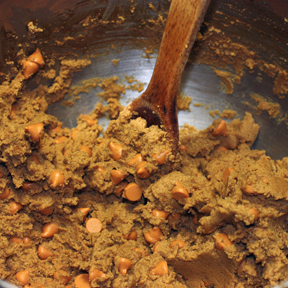
So far these have pretty much been Earl’s only special needs. And really they aren’t such bad rules to live by. Who here couldn’t stand to take it down a notch? Anyone? And keeping a stash of nice little treats on hand? That’s pretty much a no-brainer. So I’m gradually learning to pad my schedule a bit – it’s kind of refreshing to feel a little less rushed. And I really have been eating a lot of butterscotches lately. Which is nice, because I’d sort of forgotten how much I enjoy butterscotch. And it has also reminded me of a delicious cookie combination. Ginger and butterscotch.

I first had this cookie a few years ago at Rabbit’s Bakery – a cozy little shop near my Mom’s in Lake City, MN – and it knocked my socks off. It might not be for everyone, but if you dig these two flavors, I assure you they were meant for one another. It’s a perfect fall weather cookie too.
So yesterday, on our first real cool, rainy day of the season, Earl inspired me to slow down, turn on the oven, and bake. And on our next sunny fall day, I plan to head out to the nearest leaf pile, cookies in one pocket, Pup-Peroni sticks in the other and take in the last rays of fading summer sun with my new friend. Why not?
Ginger-Butterscotch Cookies
(adapted from Nestle Tollhouse)
3 cups flour (I like a combo of white and whole wheat)
2 teaspoons baking soda
1 1/2 teaspoons ground cinnamon
2 teaspoons ground ginger
3/4 teaspoon ground cloves
1/2 teaspoon salt
1 cup butter
1 cup packed brown sugar
1 large egg
1/3 cup full flavored molasses
8 – 11 ounces butterscotch chips
Sift flour, baking soda, cinnamon, ginger, cloves and salt in small bowl.
Beat butter, sugar, egg and molasses in large mixer bowl until creamy. Gradually beat in flour mixture until well blended. Stir in butterscotch chips. Drop by rounded tablespoon onto ungreased baking sheets.
Bake for 10-12 minutes at 350º F until lightly browned. Cool on baking sheets for 2 minutes and remove to wire racks to cool completely.
Makes about 4 dozen

cold chaser

This is going to sound pathetic, but I have been trying to turn out a batch of chocolate chip cookies since the beginning of September. My husband Mark is a science teacher at Bayfield High School. And I know from experience that the transition back into the chaos of the classroom can be a rough one. So naturally I thought chocolate chip cookies would help.

I must have taken the butter out to come to room temperature at lest a dozen times, only to return it – untouched – back to the fridge at the end of another long day. When I finally did get the dough mixed up, it was a two day affair to get all the cookies into the oven and baked. And after all that, they didn’t even come out looking very pretty. But at least they taste good.

It appears, however, that my efforts might have come a little too late. Mark flopped down on the couch this weekend and succumbed to his fate. “They finally  got me,” he moaned. It’s inevitable. It happens every fall. It’s only a matter of when. The dreaded back-to-school cold. And this year’s is a doozy – already making its way deep into his lungs.

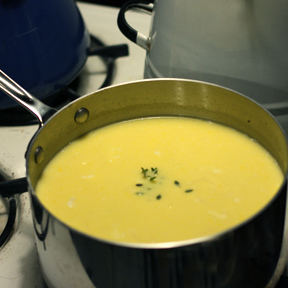
But this time I was ready for duty. Garlic! This boy needs garlic and lots of it. And so as a cure for Mark (and a preventative for myself) I made up a steaming pot of garlic soup. It’s a simple soup with just a handful of ingredients, but don’t let that fool you. Its flavor is rich and complex. Head cold or not, if it doesn’t bolster your spirits after a long day, I don’t know what will.

The key is to make this soup with the freshest garlic you can find. Older garlic runs the risk of being too hot and sharp. This time around I used a nice mild Spanish Roja. The recipe, which comes via the New York Times Cookbook, calls for roughly 36 cloves of garlic. Since garlic cloves can vary quite a bit in size, I’ve settled on average clove weight of 3 to 4 grams. So depending on the garlic I’m using, I typically chop up anywhere from 100 – 150 grams of garlic. Cold? What cold? I knew it was working when midway through dinner Mark sighed and said he wanted to drink the soup like milkshake.

Soupe à L’ail (garlic soup)
Adapted from the Essential New York Times Cookbook

2 tablespoons unsalted butter
36 average size, cloves of garlic (100-150 grams), peeled and roughly chopped
8 cups water
Salt and ground pepper to taste
3 ounces capallini or other thin pasta, broken into pieces
6 eggs, separated
3 tablespoons white wine vinegar
Fresh thyme for garnish
Olive oil

Melt the butter and oil in a large soup pan. Add the garlic and cook, stirring for about a minute – do not let it brown. Add the water and about a teaspoon of sea salt. Bring to a boil, cover, reduce heat and simmer for 15 minutes.

Strain the cooking liquid and reserve the garlic. Put 1/2 cup of the cooking liquid and all of the garlic into a blender or food processor and whiz into a smooth puree.

Return the rest of the cooking liquid along with the garlic puree back to the soup pot and bring it to a boil. Add the pasta. Cook for about 3 minutes, until pasta is just tender. Meanwhile, blend the egg yolks with the vinegar.

Turn off the heat, pour the egg whites into the hot soup, cover and wait a few minute until the egg white form a cloud-like mixture. Do not stir them in. When the whites are fully cooked, add the egg yolk/vinegar mixture and stir very slowly to combine. Adjust seasoning if necessary. Garnish with a sprig of fresh thyme and a drizzle of olive oil.


instapig

No Instagram images were found.