Archive for the 'bee yard' Category


stepping back

Why is it that one of life’s lessons feels the need to repeatedly hit me over the head? Thick skulled? Slow learner? I don’t know. But here’s what I do know. Keeping bees is good for me. And it has relatively little to do with any honey I garner. But it has everything to do with being a part of something ancient, something miraculous, and allowing it to seep in and be just that. A mystery. Sounds simple, I know. But for some of us – that whole “letting it be” thing? It’s just not that easy.

Here’s the nitty-gritty truth. I like to be in control. I like to know what is going on – and why. I like clear instructions. I like to work hard and get results and answers. I like things that are specific. Give me instructions. Give me a recipe. But, as it turns out, honeybees are not conducive to any of this. I read endlessly about honeybees. I participate in online honeybee chats. I go to honeybee meetings. I give it my all when it comes to understanding honeybees. And still, they always seem to one up me.
My girls have been having an off summer. And it pains me to tell you that I can not figure out why. I can’t blame it on the weather, I can’t even blame it on my management skills. By all indications, things should be going well. But something is off. Valerie’s hive has been lackadaisical all summer – and with no clear indication as to why. I actually miss her girls’ sassiness. Freeda, bless her little bee heart, has been charging along as usual, setting an exemplarily example of what an A+ beehive should look like in the height of summer. Until a few weeks ago that is. I was doing a routine hive check and I got the eerie sense that something was wrong. I buttoned her back up, gave the hive a pat, and hoped it was just me being silly.

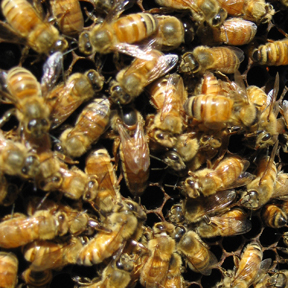
But when I checked her hive again the other day, I was dismayed. No capped brood + no larvae + no eggs = no queen. No Freeda. I could tell right away that her girls were squirrelly and unusually frantic. A bad sign. It was all I could do to hold in my tears as I pulled out frame after empty frame from the brood nest. Lest you think I am entirely sappy, I should clarify that Freeda is the queen bee I have had the longest relationship with. She has set the bar for all others. So I feel a particular bond with her. Her absence was palpable. (That’s her in the photo above – right in the center.)

A hive without a queen is not really a hive. I immediately ran through my options. I could get online and search for an available queen, paying an exorbitant price to overnight her to northern Wisconsin. Or better yet, I could call my good friend and bee guru Kris (who lives conveniently down the road) to she if has any of her northern hardy, queen stock to spare.

Another option would be to take a frame of eggs from Valerie’s hive and give it to Freeda’s girls so they can raise a new queen. A slower process by far, but one that is entirely amazing. Bees are the only species I know of that can dictate the outcome of an egg based on how they treat it. The majority of eggs in a hive develop into more female worker bees. But should the need for a new queen arise, the workers can feed an egg a special substance called royal jelly and raise a new queen from an egg that would otherwise become a worker bee. How and why they know to do this astounds me. But when it happens, you know it. Queen cells are very distinct. They look like full-size peanuts hanging off of an otherwise flat frame of brood.

I opted to stick a frame of eggs from Valerie’s hive in just for insurance, which also bought me a bit of time to check into my other options. I called Kris first. No queens. Drats. I did find a queen in Georgia that could be sent via UPS. But the cost coupled with the fact that I am heading off to the Boundary Waters for a few days of paddling, deterred me. The new queen might arrive in time, but if she was at all delayed, she’d spend a sad week on my doorstep and neither of us would be the better for it. So I have decided to let the bees take charge and run their own show. After years of keeping bees, I fully acknowledge that the bees almost always know better than I do. I might think I know, and as much as I might think they should be doing something differently, I’m really second fiddle to it all. My girls repeatedly remind me to relax and take a big step back from things. I love them for that.

Even so, I can’t help mentally wrestling with what might have transpired in the hive. The last time I looked, I found one fully developed, neatly exited queen cell in the hive. It’s possible that they decided to swarm. Which means that once the new queen cell was underway and developing, the older bees with Freeda in tow took flight from the hive in search of less crowded accommodations (a simply astonishing sight and sound to behold). After Freeda’s new daughter hatched (a solid two weeks from the egg stage) she’d have to leave the hive in order to complete a few mating flights. So it could be that I looked in on the hive on an afternoon when the new queen was simply out. The timing was perfect for this. It could also be that the new queen went out, but never made it back – leaving the hive queenless, and eggless. A bad combination. Or, for all I know, they were planning on swarming but something happened to Freeda before they could pull it off.

If pressed, I could probably provide a half dozen renditions of what might have happened. But eventually, after several whacks to the head, I realize that I don’t need to figure it out. The girls certainly aren’t asking me to. They’re forging on in whatever way they can. For my part, I am reminded yet again to step back and watch the mystery unfold. Maybe when I return home from canoeing and peek in the hive I’ll see that tell-tale peanut, signifying one of Valerie’s daughters is about to hatch. Or perhaps there will already be new eggs and larvae, indicating that Freeda’s daughter made it back to the hive to carry on the legacy. And it’s entirely possible that I still won’t have a clue. And that’s okay too. I can let it be.

hunker in

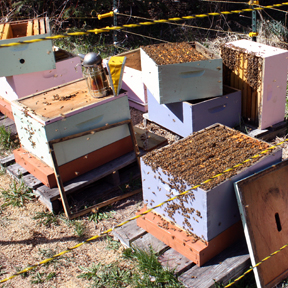
There is nothing more thrilling for me than a wintertime trip to the bee yard. I generally pack my camera, a shovel, and a thermal mug of hot green tea. Once there, I literally sprint from the car through the deep snow to get to the hives. Then, like a little kid, I drop down on my knees in front of the snow-capped towers. The suspense of it gets to me every time. Are they going to be alive? I eagerly put my ear straight up against the hive entrance and listen for the tell-tale hum. Valerie’s hive, check. Queen Ruth Wilson, check. And my lovely Freeda? Three for three! That’s how it went today anyway.

Now I can relax and go back for my tea. I shovel out around the electric bear fence to keep the weight of the snow from stretching out the woven wire. I scrape the snow and ice from their front porches and clean up around the hives. And then I plop down and sit with my head up against a hive. It’s bitterly cold, but for once it doesn’t matter. There’s life in there! I can hear it! I look around at the frozen winter landscape and laugh.

On a mild winter day the girls will certainly be standing by at their entrance, surveying the day. If it’s nice enough they might even venture out for a little spin – or what is technically called a cleansing flight (they keep their quarters clean). But on a day like today when the mercury is struggling to get up to 0º F, they stay bundled in tight.

Bees don’t hibernate. Instead, they spend their winter shivering their flight muscles to stay warm and heat the hive. They band together and form a cluster in the center of the hive. The colder it gets, the tighter of a cluster they form around the queen. They maintain an internal cluster temperature of anywhere from 70 – 95º F. The bees sort of continually rotate through from the outer edge of the cluster into the center, accessing their stored food supplies as they go. How cool is that?

If that’s not impressive enough, get this. A winter bee is physiologically different from a summer bee. They have fatter bodies and a different blood protein profile than a standard summer bee. And they live considerably longer – 4 to 6 months versus the reckless 35 day lifespan of a summer gal. They are specifically designed to make sure the colony survives the winter. Somehow the cooler fall weather triggers the girls into rearing stockier, heartier winter bees. That blows my mind.

Any hive that is going to make it through the winter needs enough stored honey to see them through. But the danger an over wintering hive faces is if it gets too cold for too long, the bees won’t be able to shift in the cluster to access their food. So I always get a little nervous when the first arctic blast of the season hits. Last night the thermometer dropped to -11º F and more of the same is in store for tonight. But I’ve done all that I can. I down the last of my tea, give each hive a pat and tell my girls to hunker in just a little tighter.

taste buds talk

One of the most thrilling aspects of bee keeping is having that first taste of each season’s honey. I’ve certainly been known to sneak some honey periodically throughout the summer, but generally I wait until the end of August to pull the honey supers off – which means I get a mix of everything the bees have foraged on all spring and summer. It always such a surprise to see what the girls have brought in each year.

I’ll never forget my very first honey crop and its delicate apple flavor. At the time, my bees were located in the heart of Bayfield’s “orchard district,” which meant no shortage of fruit blossoms to forage on. And then there was the harvest that had a decidedly minty undertone. That was the year when the basswood trees went crazy with blooms all summer long. I’ve pulled off late fall supers that are filled with the heady dark brown nectar from goldenrod and asters. And I’ve taken plenty of swipes of that gorgeous, light, early summer clover honey while working in the hives. But my main fall honey harvest is like a little mystery I get to try and crack each year. The color and taste of each super full of honey is my main clue to where the girls have been spending their summer afternoons.

So I couldn’t decide if I was more amused or distraught when I read an article in last Monday’s NY Times about several hives of New York bees who evidently spent their summer feeding on the sweet run off from a nearby maraschino cherry factory. The results were neon red frames of honey. The sort of gaudy red that only red dye number 40 can produce. Albeit shocking, it is a great example of how amazingly distinct honey can be, and how each honey is a direct link to what the bees are feeding on.

Foraging bees will travel up to 3 miles for food. And when they find something they like, word gets around quickly. Lets face it – taste buds talk, and bees are no exception. Bees not only have taste receptors on their tongues, but on their feet and legs as well (how cool is that?!). So who’s to fault them for choosing some manmade, red inflicted corn syrup over a fresh, dewy clover blossom? I’m no one to talk – I still have a soft spot for those cloyingly sweet cherries. They saw my brother and me through many a shirley-temple based cocktail hours as kids.

But unlike humans, bees shouldn’t have to know better. As a beekeeper, I feel a responsibility to keep my hives as healthy as I can. Yet I don’t think I could begrudge my girls their bliss should they happen to stumble upon some “junk” food. How lovely to go through life feasting on the best tasting things you can find in a 3-mile radius. I envy such simplicity.

last hurrah

The transition from fall into winter can be brutal in the bee yard. It’s the time of year when the drones (the larger, sort of bumbling, non-stinging male bees) are literally dragged out of the hive. The female worker bees preform this task as a way to bring the hive’s population down. Fewer bees in the winter cluster means fewer bellies to feed. And not taking risks with the food supply is a sure way to increase a colony’s odds of making it through the long Wisconsin winter.
I hate to say it, but really, the drones wouldn’t stand a chance with any plea they might make to stay. They just don’t have a whole lot in their favor. Drones don’t forage. They don’t participate in making honey. They don’t work as nurse bees – tending larvae, or as guard bees – protecting the colony. They don’t do any comb construction. To make matters worse, they defecate in the hive, leaving the females to clean up after them (the ladies are fastidious and exit the hive to do their business). And to top it off, drone larvae is the preferred breeding ground for the deadly varroa mite.
When it comes right down to it, a drone’s only “job” is to circle high in the air some distance from the hive, waiting for rogue, unmated queens to come by. A queen only makes one mating flight in her life, so I have to think it is pretty lonely work for the average drone. What’s worse, should they actually get the chance to put the moves on a queen and pass on their lineage, that’s it – death is soon to follow. This doesn’t seem to get them down. Nor does getting chucked out of the hive to meet their end with the winter chill. Maybe it’s because I can think of no worse way to go than freezing to death, but I tend to have a lot of sympathy for the drones. I cringe to witness this annual ritual.
Sadly, I think we might have just seen the last of our languid fall days with that signature slanty afternoon light. But I cherished every last  one of them – not only selfishly, but for the drones’ sake too. This quote I stumbled across in one of my bee books couldn’t express my sentiments better:
“If skies remain clear, the air warm, and pollen and nectar abound in the flowers, the worker, through a kind of forgetful indulgence, or over-scrupulous prudence perhaps, will for a short time longer endure the importunate, disastrous presence of the males.”
I snapped this photo on Friday – just before the snow set in. Two drones standing side by side (their larger eyes and slightly burlier builds set them apart). At the risk of sounding anthropomorphic, I like to think they are enjoying one last fall afternoon on the front porch – remembering a summer well spent. One last hurrah.

still space

I suppose it’s time for me to introduce my girls. I have three hives of bees that I tend – all brimming with thousands of female worker bees and one queen. I’ll let you meet them in the order I typically work them. Freeda-b is the rockstar queen. My oldest queen by far, but you’d never guess it. She can easily outlay my other two more spry queens – filling each frame flawlessly with gorgeous brood. And her girls consistently make more honey than any hive I’ve ever kept. I’ve not ventured into the tricky art of raising queens, but Freeda-b is just the type who would lead me there. Her enthusiasm is contagious.

Next in line is Ruth Wilson (named after my great grandmother – not the English actress). Steadfast and sweet. I love her hive. Her bees remind me of the kid who really has to work at something to be good, you know the type – as opposed to the one equipped with all the natural talent and good looks to boot. Ruth Wilson also runs a “no attitude” ship. Her girls are a mild tempered and easy to work with – a treat really.

Which is pretty much the exact opposite of Valerie’s hive. I consider her my problem child. She is named in honor of Miracle Max’s wife. When I installed her into the hive as a young queen, I found my self asking “think it’ll work?” Which, to be fair, is a question I frequently ask myself in the bee yard, but this time the answer was clearly “it’d take a miracle.” Let’s just say the conditions were less than ideal, and there was a wee bit of mayhem going on. But she rallied and she seems committed to live up to her hard-knocks upbringing – her girls are SASSY. This was my first summer with her, but her crew has all the makings to be top-notch honey makers. I’m expecting great things from them next season, even if I have to put up with a little cheek.

But there is something else you should know about my hives. Bees make me nervous. They always have. Now, I’ve never been the flailing, squealing, swatting type around bees. I really want to like them. And I do. But they still make me jumpy. Every time I suit up to go out to the bee yard, my pulse increases and my body temp rises ever so slightly. Sometimes I even get the stomach flutters. That disconnect between instinct and rational thought is a fascinating one, isn’t it? But here’s the kicker. As soon as I am immersed with the girls – even the surly ones – my nerves settle and everything magically drops away. And I mean everything. For once, I don’t think about the work project sitting on my desk, or the potatoes that need to be dug before the ground freezes, or the phone call I should have made. I don’t replay any past conversations in my head, or dwell on what the future may or may not hold for me. Time stops and that’s all there is. Just bees. Not much else has this effect on me. I meditate daily, I practice yoga, I consciously relax. But for all my attempts at enlightenment, my mind still manages to have it’s fair share of private fracases.

I’m sure my motivation to set up a single hive five years ago had a lot to do with honey. But really I have come to see that luscious liquid gold as an added perk to a pursuit that finally gives me that sought after still space. My girls also manage to keep me endlessly curious  – if even slightly nervous. I love those sort of unexpected surprises that life dishes out.


instapig

No Instagram images were found.